Tuesday, June 18, 2013

Review: Stickets for iPhone and iPad

Match 3 puzzle games are a dime a dozen on the App Store. I don't find them particularly interesting, and usually stay well clear of them.
Stickets, however, is pretty darn good. It is highly original, exceptionally polished, and bloody hard.
Stickets is the lastest game released by the Australian developer Wanderlands. One of their earlier creations is the brilliant Impasse, which is currently only available as a Flash game. Sadly, it is so good that it has been unofficially ported multiple times to iPhone, and I even reviewed one of those copycats a few weeks ago, not knowing that it wasn't an original game (don't look for that review now, I've removed it).

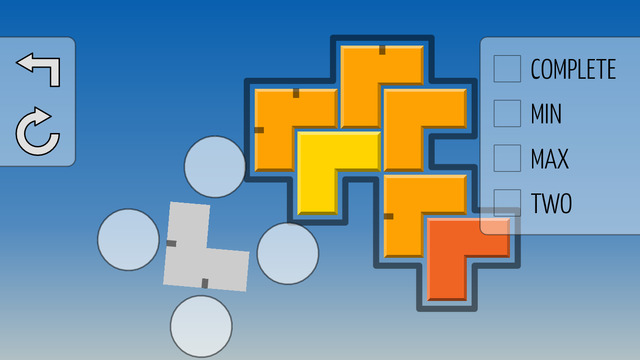
But let's go back to Stickets. You play on a 5x5 board. It starts out nicely empty, but that won't last for long. At the bottom of the screen there are four L trominoes, each one using a random permutation of three colors. Every move consists of picking one of the tromionoes, and placing it in a free place on the board. When you do so, the tromino is replaced by another one with the same shape but different color permutation, and your score increases by 1.
When you put the pieces on the board, you need to try creating areas of the same color. When an area contains at least three tiles, you can tap on it to make it disappear. You can make larger areas if you like, but that won't give you more points.

When the board is full and you can't make any more moves, it's game over.

Playing this game is surprisingly challenging and interesting. Even if the rules are very simple, the random permutation of the colors makes every move different from the previous one. The game keeps you on the edge of your seat all the time, because even a single mistake can be fatal. You don't know in advance which pieces you'll be served next, so you need to take into account the four pieces that you can see, and develop a strategy to keep different options open.

When the game ends, the imprudent player will blame misfortune, because they didn't receive the pieces they were waiting for. The wise player will know that they made a mistake, which prevented them from taking advantage of the pieces they had available.

In principle, if you didn't make mistakes, you could play forever. Thankfully, the game will save the board state when you quit, and allow you to resume from where you left. I can imagine that some dedicated players will achieve very high scores over the course of weeks or months.

Here are a couple of tips to help you going:
- try to prefer L shaped matches. Avoid I shaped matches because after you remove them, you can't fill the space with a new piece.
- avoid creating checkerboard patters, which would be hard to remove. Try to ensure that every time you put down a piece, at least two of its tiles match the color of neighboring tiles.

Of course, that's easier said than done.

So far, I've only talked about Space mode, which is the game's primary mode. But there's more. Score 50 points in Space mode (which might seem impossible at first, but it's quite doable after you develop a decent strategy) and you'll unlock Time mode.

Time mode keeps the basic mechanics, but turns the game on its head. While Space moves at a deliberate pace and encourages careful, thorough thinking, Time forces you to think on your feet and move as quickly as possible. Every piece you put on the board turns into a time bomb, which will explode after a few seconds.
You have 12 lives at the beginning, you lose a life every time a bomb explodes. When you lose all lives, it's game over. In this mode, you can't get stuck: even if you do, eventually some tiles will explode and free more space. You earn more lives by making matches of 4 or more tiles, so it's necessary to develop a strategy less focused on precise placement of the pieces and more on creating large groups of matching tiles. And doing it quickly.

There would be a third game mode, called Puzzle. It sounds intriguing, and from what I could see peeking into the game's package, it features interesting challenges like:
- fill the whole grid
- lose in 4 moves (place 4 pieces so that there is no more room for another one)
- create a symmetrical pattern in exactly 5 moves
and my favorite:
- prove that Stickets in Space mode is infinite.

Unfortunately I can't yet talk about Puzzle mode because, despite my best efforts, I'm nowhere near the score of 50 in Time mode that would be needed to unlock it.

I think this is a major flaw in the game design, for multiple reasons. It's arbitrary, it's annoying, and it's just too hard for most players. Indeed, looking at the Game Center leaderboards (which, oddly, can't be accessed from inside the game) there are many people that have scored more than 50 points in Space mode, but few did the same in Time mode.

Maybe if I trained really hard I might be able to get that score, but the point is that I don't want to. I like relaxed thinking and I don't want to be forced to play with a clock ticking against me. So for the time being my optimal strategy to beat Time mode is just... waiting for a game update to be released :-)

I'm also going to mention that the user interface features three different themes, which affect both the color palette and the sound. Sound is very well done, and changes significantly depending on the game mode and the theme.

The creative mind behind this game is a talented 20 years old, Harry Lee. There's an interesting article about him on Kotaku. I'm sure he'll make great things. He'll just need to tune the difficulty of his games bearing in mind that most people in the world are a lot less intelligent than him :-)

Stickets is definitely one of the most interesting puzzle games released this year. It just needs to be fixed to allow playing Puzzle mode without being forced through Time mode, and then it'll be a winner.


Summary

Nontrivialness★★★★★
Logical Reasoning★★★★☆
User Interface★★★★☆
Presentation★★★★☆
Loading Time★★★★★
Saves Partial Progress
Status Bar

©2013 Nicola Salmoria. Unauthorized use and/or duplication without express and written permission is strictly prohibited. Excerpts and links may be used, provided that full and clear credit is given to Nicola Salmoria and nontrivialgames.blogspot.com with appropriate and specific direction to the original content.

Thursday, June 13, 2013

Quick Look: Gua-Le-Ni for iPhone and iPad

Gua-Le-Ni by the Italian developer Double Jungle is not the kind of puzzle game that I usually review (or play!) because it's more a game of speed and memory than of logic. However it is so bizarre and artistic that I thought it deserved a mention.
Originally released in 2011 for iPad only, it has recently been updated to support iPhone as well.
If you are wondering what Gua-Le-Ni actually means, it's just the name of the game's designer, Stefano Gualeni.

Essentially, the game consists of looking at monstrous creatures, composed of parts of various animals, and reconstruct their names by rotating and reordering the dice at the bottom of the screen.
For example, this creature has the head of a Rabbit and the body of a Condor, hence it is called a Rab-Dor.
Creatures can be up to 4 parts long. Here's a 3 parts one, a Lob-Rus-Hog.

There are three game modes: in the two main ones, you need to compose the name of the creatures while they walk across the screen; if they walk out before you've finished, it's game over. There are also complications like feeding the creatures with their preferred food in order to slow them down.

The third game mode is totally different. It is called "Poetry", and it is accompanied by verses and illustrations of an odd poem. This mode requires memory rather than speed. Some creatures walk across the screen, and after the last one has left you have to compose the names of all of them. When you have to remember 3 creatures, each one 3 parts long, this starts getting difficult. Definitely a good training for memory.

Where the game really shines is presentation. Most of the user interface revolves around a book with realistically flipping pages and gorgeous hand drawn graphics. Sound is equally good, and the humorous voice acting fits the mood.

A selling point of the game is that biometrics were used to finely balance the difficulty curve, optimising its effect on the players. There's an article by Stefano Gualeni on Gamastura talking about this, and other articles can be found on his personal site.

If you are looking for a diversion from logic puzzles, this is surely a worthy one to look at.


©2013 Nicola Salmoria. Unauthorized use and/or duplication without express and written permission is strictly prohibited. Excerpts and links may be used, provided that full and clear credit is given to Nicola Salmoria and nontrivialgames.blogspot.com with appropriate and specific direction to the original content.

Monday, June 10, 2013

Update: Fields 1.0.4

Fields by Kevin Langdon has just been updated and it addressed the criticism I made in my previous review.
In its first release the game showed a lot of potential: the flower theme fits perfectly the mechanics of the puzzles. Unfortunately, I was disappointed that some puzzles didn't have a unique solution. I'm happy to see that this issue has been fully fixed in the update.
There are 100 new puzzles to solve, and two extra packs of 100 puzzles of size 4x5 and 5x6 that can be unlocked through in-app purchases. Hopefully more packs at larger sizes will be available in a future update.
Now that the puzzles have a unique solution, they are a joy to solve. I wish the user interface were just a bit smoother in the transitions, but apart from that the game is strongly recommended.

©2013 Nicola Salmoria. Unauthorized use and/or duplication without express and written permission is strictly prohibited. Excerpts and links may be used, provided that full and clear credit is given to Nicola Salmoria and nontrivialgames.blogspot.com with appropriate and specific direction to the original content.

Friday, June 7, 2013

Review: Bloom Box for iPhone and iPad

Bloom Box took me by surprise. Seeing that it was advertised on the home page of Touch Arcade, I expected it to be entirely targeted at casual gamers, but its mechanics are actually quite good.

What intrigued me was the last sentence of the app description: "In collaboration with Pyrosphere".
Pyrosphere is the developer of the excellent Lazors, so that was certainly a good start.
Indeed, after some research, it turns out that this release by Nexx Studio is a remake, with better graphics, of a game with the same title that Pyrosphere released in 2011. The original game is no longer available on the App Store.
The playing area is an 8x8 grid representing a garden. In the garden there are a few boxes, most of which can be moved around. One of the boxes cannot be moved and is connected by a white line to a button at the bottom of the screen. When you tap the button, a drop will be shot toward the box, and the box will explode, shooting more drops on nearby tiles. If those drops hit other boxes, they'll explode too, causing a chain reaction.
To solve a puzzle you just need to hit all the boxes, but to solve it properly you also need to hit three stars. There can be multiple ways to do it.
Note also that there are holes in the garden. You can't put a box over those tiles.
The labels on the boxes indicate which tiles they hit when they explode. Initially you play with blue and red boxes, which shoot orthogonally and diagonally.
Later, green boxes appear, which shoot orthogonally but 2 tiles away. Helpfully, when you drag a box the tiles targeted by it are highlighted.
Further into the game, you find purple boxes, which shoot like the Knight moves in chess.
I haven't solved all puzzles yet so there might be even more box types to see.

The puzzles are well designed and even with a small number of boxes, the solution can be counterintuitive and elusive. Logic helps a lot in weeding out impossible arrangements and isolate the solution.

There are currently 120 puzzles, split across three "gardens" plus a "Star Garden". The levels in the three gardens are unlocked in sequence, and the ones in the Star Garden are unlocked one by one when you earn enough stars. The Star Garden puzzles are apparently supposed to be slightly harder than the others.

The puzzles in this game aren't very difficult, but they aren't trivial either, and I found them to be very fun. It's definitely worth a try; there is also a free version available.

Summary

Nontrivialness★★★☆☆
Logical Reasoning★★★★☆
User Interface★★★☆☆
Presentation★★★☆☆
Loading Time★★★★★
Saves Partial Progress
Status Bar

©2013 Nicola Salmoria. Unauthorized use and/or duplication without express and written permission is strictly prohibited. Excerpts and links may be used, provided that full and clear credit is given to Nicola Salmoria and nontrivialgames.blogspot.com with appropriate and specific direction to the original content.

Sunday, June 2, 2013

Review: Vaccine Case for iPhone and iPad

Vaccine Case by Wataru Nakano is a puzzle game from Japan, based on truly brilliant mechanics and a perfectly fitting theme.
I suggest turning off the music. Otherwise it might get stuck in your head for all day :-)

The basic idea is this: you see the map of a lab. Some rooms contain viruses, other rooms contain antidote gas. When gas comes in contact with a virus of the same color, both disappear. The goal is to remove all viruses.
To play the game, you control doors. The basic type of door can only be opened. When you open a door, gas spreads as far as it can go and cannot be stopped.
The most useful doors can be both opened and closed. This is important because, since when you kill a virus the gas you used disappears as well, you often need to seal some gas into a closed room to reuse it later. The room at the top of this level has that kind of door.
Another important limitation is that you cannot open a door if it separates two rooms containing gas of different colors. So in the example above, after opening the door on the left you wouldn't be able to open the door on the top right.

In a tradition common to other Japanese puzzles, many levels are shaped like animals, fruit, or other objects. This one is a jar. Also note that a few of the viruses have a shield surrounding them. This means that you have to hit them twice to kill them.
In some puzzles, there are also doors protected by a force field, which cannot be used until all viruses of that color have been killed.
Finally, a puzzle game involving colors wouldn't be complete without a way to mix them. This is done using fans. Here you need to mix blue and yellow to get green.
Fans can also be used simply to move gas from one room to another, as if you opened a door and immediately closed it again (which isn't possible with normal doors).

Solving these puzzles is enjoyable and requires finding the correct order that viruses need to be taken down while also allowing you to save some gas to kill the remaining ones. The solution often isn't unique, but in the hardest puzzles there is less freedom of choice.

There's a total of 100 puzzles, split across 5 difficulty levels. You start with 20 unlocked, and then every 10 puzzles solved, a new group of 10 is unlocked.
The puzzles vary in shape and size. The largest ones require precise touches on the iPhone's small screen, however if you make a mistake you can always use the undo button.

The price is currently $2.99, which I think is justified by the originality of the mechanics, however it dropped as low as $0.99 a few times since when the game was released in 2011.
If you want to try a free version first, there are actually two:
Vaccine Case LITE - 12 levels that show most of the mechanics of the full version.
Vacchine Case [headache] - 12 new, exceptionally hard levels. I solved only 1 of them!


Summary

Nontrivialness★★★★★
Logical Reasoning★★★★★
User Interface★★★☆☆
Presentation★★★☆☆
Loading Time★★★★★
Saves Partial Progress
Status Bar

©2013 Nicola Salmoria. Unauthorized use and/or duplication without express and written permission is strictly prohibited. Excerpts and links may be used, provided that full and clear credit is given to Nicola Salmoria and nontrivialgames.blogspot.com with appropriate and specific direction to the original content.

Friday, May 31, 2013

Rants and WIP

Lately I've slightly reduced the frequency of my reviews, for a couple of reasons.

The main one is that, sadly, the past few weeks on the App Store have been less than memorable for puzzle games. There's a deluge of Rush Hour copycats, and an annoying amount of apps that try to have titles and icons similar to the apparently very popular Candy Crush Saga, but I could find very few puzzle games of any interest.

A couple of games had pretty good puzzle mechanics. Too good, apparently, to be original. Indeed, I recognised Raf Peeter's style in one of them, and sure enough, after some quick research I found it to be a blatant copy of Hide & Seek Safari.
I had already published a positive review of another game, when Tom Cutrofello told me it was a clone of Lunar Lockout. That's not necessarily a bad thing per se, but certainly the origin of the puzzle should have been acknowledge by the author of the app.


The other reason for the less frequent reviews is that, after the release of Brain Twirler, I've been working on the design of my next game.

My initial plan was to make a new version of Twin Beams, featuring a new interface and a new pack of easier puzzles. However, after pondering over it, I came to the conclusion that it was better to do something different, though still based on similar rules. The main reasons for this are:
  • Star Battle, which is the puzzle underlying Twin Beams, is probably the best pen-and-paper puzzle I've ever played. Twin Beams makes it even more enjoyable by automatically taking care of trivial exclusions, but it remains a puzzle of sequential placement: it isn't as interactive as a smartphone allows.
  • Playing Twin Beams at the harder difficulty levels, the deductions needed to proceed by pure logic are sometimes very difficult. It is often quicker to solve the puzzles by occasionally making guesses and tracing back with the undo function if necessary. While using logic alone is the method of choice for purists, a lot of people just want to have fun and solve the puzzles.
  • The rules of Twin Beams aren't complicated, but they are difficult to explain clearly to a novice, and even the easy puzzles are too hard for many people. While I want to make nontrivial games, I'd also like as many people as possible to enjoy playing them.
So I had two essential goals: make Twin Beams easier, and more interactive.

To make it easier, the obvious choice was using the Star Battle rules with 1 star per row/column/area instead of 2.
To make it more interactive, I borrowed Lazor's fundamental idea of placing all markers on the board from the start and letting the user move them around, instead of starting with an empty board and adding markers to it.

Regarding the interactivity, the initial idea I had was to start with a marker in every area, and only allow it to be moved inside that area. So to solve the puzzle the player would only need to ensure that the other rules were satisfied (1 marker per row and column, and no markers next to each other). I prototyped this, but I didn't think it worked well. I then had a different idea to limit the player's movements without limiting them, but I'll talk about it another time.

While testing, I also noticed that the rule of not having markers next to each other was partially redundant: since there must be only 1 marker per row and column anyway, they could be adjacent only diagonally. Was it necessary to leave this rule? I decided it wasn't, so with the goal of making the game as simple as possible, I dropped it. Essentially, this turned the puzzles into a variant of the Rooks problem, with the additonal costraint of having only one rook in each area.

If you are curious. this is what the current prototype looks like. As an exercise, you can also try solving the puzzle :-)
Next time I'll talk about how I'm selecting the puzzles to be included in the game, which turned out to be a lot more difficult than I expected. In the meantime, if you have questions or suggestions, don't be shy and leave a comment!


©2013 Nicola Salmoria. Unauthorized use and/or duplication without express and written permission is strictly prohibited. Excerpts and links may be used, provided that full and clear credit is given to Nicola Salmoria and nontrivialgames.blogspot.com with appropriate and specific direction to the original content.