Showing posts with label sliding tiles. Show all posts

Friday, June 20, 2014

Review: Titanic for iPhone and iPad

Titanic (also free) is a very original, hardcore logic puzzle game, a kind which nowadays is rarely seen on the App Store.

Originally released in 2012, it recently received a major update, which doubles the number of levels. But not only that: the new levels are based on a new mechanic, which turns it into a very different puzzle. So this effectively more than doubles the value of the game.
Developed by SmartGames, like their other two games Roadblock and Temple Trap, it's a digital adaptation of a clever physical puzzle with the same name.

Like most of Raf Peeters' puzzles, Titanic's theme is not just cosmetical, but it is strongly tied to the mechanics.

Wednesday, May 21, 2014

Review: WrapSlide for iPhone and iPad

The Rubik's Cube turned 40 recently, and there's little doubt that it has been one of the most influential puzzles ever invented. Many puzzle games on the App Store compare themselves to the Cube, but in most cases that's just marketing fluff. WrapSlide, however, is a different story.
Developed by Alewyn Burger, a researcher at Stellenbosch University (South Africa), it might look like just another toroidal sliding block puzzle. But looks, in this case, are very deceiving. The movement mechanics are different from the usual ones, and produce a very challenging puzzle.

Friday, March 7, 2014

Review: Color Tangled for iPhone and iPad

Color Tangled is a good example of how the App Store is being ruined by bad business models. For each one of the creatively original games that I review on this blog, there are... hundreds? thousands? of unoriginal lookalikes. And I'm not just talking about the current flood of Flappy Bird clones, nor of the apparently endless flow of reskins of Flow Free. This is a pervasive problem, and it's often not easy for the customer to understand what's going on.
I like graph transport puzzles, and there is a good selection of them on the App Store. Subway Shuffle and Sky Scramble, for example, are excellent choices based on original ideas. Color Tangled is based on a much simpler idea, but it would still be fun.

Monday, March 3, 2014

Review: Slide Boxes for iPhone and iPad

Slide Boxes by George Novozhenin is a good example of how the App Store can still provide some surprises from time to time, even if lately it seems to be completely flooded by clones of Flappy Bird and Flow Free.
The game is a very clever twist on sliding block puzzles. In this case you don't slide single pieces, but whole lines at a time. There is so much free space on the boards that one would expect the puzzles to be simple to solve, but there's a catch.

Friday, February 28, 2014

Review: Shapist for iPad

Shapist by Ori Takemura and Dmitry Kurilchenko succeeds in bringing new life to the classic genre of sliding block puzzles, by providing challenging puzzles and novel mechanics. Unfortunately, the touch interface falls short of the quality one expects from an iPad app.
The game features an unusually minimalist interface, having no title screen, no menus, no instructions. On startup, you just zoom in on the current puzzle and start playing.

Saturday, January 4, 2014

Review: Comboline the Touch Action Puzzle for iPhone and iPad

Comboline (also free) is a match 3 game released in 2011 by the Italian indie studio Big Bang Pixel. Christian Costanza, the graphics and game designer, kindly sent me a promo code. He also had the honor of being the first person to reach 10th Dan in Zen Garden Puzzle, which is no small feat.
I'm not much into match 3 games, especially timed ones, but I liked the simplicity of this one: there are no silly powerups or other things you can buy, it's just you and the tiles.

Thursday, November 7, 2013

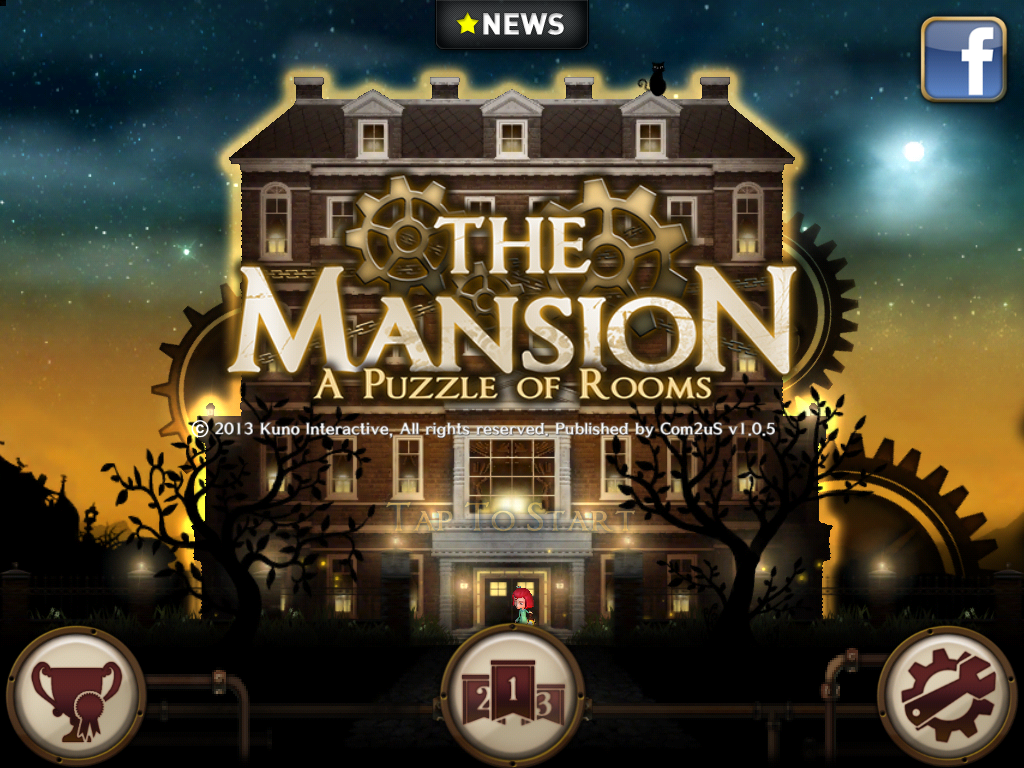
Review: The Mansion: A Puzzle of Rooms for iPhone and iPad

In 2006, a group of students of the Sungkyunkwan University, lead by Kim Jonghwa, developed an original game called Rooms. It can be played online on JayIsGames.
Later it became Rooms: The Main Building and was ported to several systems, but the iOS version is no longer available.
A sequel has now been released, called The Mansion: A Puzzle of Rooms, sharing the game mechanics, but with a completely different setting.

Sunday, November 3, 2013

Review: Circles: Rotate the Rings, Slide the Sectors, Combine the Colors for iPhone and iPad

The first release of Circles was quite boring. From the screenshots it seemed something different, but in reality it was just another impersonation of the ubiquitous toroidal sliding block puzzle. The only difference was that instead of the usual square grid, in this game the tiles are warped to form a circle.
Luckily, version 1.1 fixed this by adding several new configurations that are guaranteed to make even experts of sliding block puzzles scratch their head.

Thursday, October 24, 2013

Review: Temple Trap for iPhone and iPad

Temple Trap (also free) by SmartGames is a port of the physical puzzle by the same name.
I have already talked about the inventor of this puzzle, the Belgian Raf Peeters, in my review of Roadblock.
It is a sliding tile puzzle, with the additional twist that the tiles also form a maze, that your character needs to navigate through. If it were just that, it wouldn't be very interesting, but there's a lot more.

Wednesday, October 2, 2013

Review: Eight8Tiles for iPhone and iPad

Eight8Tiles is one of those games where half of the puzzle is figuring out the rules.
I therefore cannot say much about it without spoiling the fun of solving it yourself.

Thursday, April 25, 2013

Review: ON/OFF for iPhone and iPad

1Button is an indie studio that develops apps and games with a very distinctive, minimalistic style. Their latest puzzle game is called ON/OFF, and it has been downloaded over a million times, so you might know about it already.
At the time of writing, there's a promotion going on: by tapping a button on the developer's website, you can unlock all available levels for free.
At the core, this is a tile sliding puzzle, where each row/column scrolls at once, wrapping around at the sides of the board. On the App Store there's a gazillion of apps using these mechanics, so nothing new so far.
One novelty when compared to similar puzzles is that instead of reconstructing a picture, you have to connect coloured "switches" on the sides of the board, using tiles of the same colour.
Another novelty is that the playing area is not necessarily square or rectangular, but can be any shape, as one of the first puzzles illustrates.


Early on, another puzzle element is introduced: black tiles, which cannot wrap around from the sides of the board, therefore limiting movement possibilities.

Other elements introduced later include tiles larger than 1x1, which cause multiple rows/columns to scroll at the same time, and must not be split by wrapping around the sides of the board.
There's currently a total of 220 puzzles, split across 11 "worlds". Some worlds are free, others can be bought using in-app purchases. The puzzles can be played in any order, but some worlds are locked until all puzzles in the previous world are solved.

The puzzles in this game can be hard, however my feeling is that they are more tedious than difficult. The boards are often unnecessarily large, as some of the screenshots in this review illustrate. Solving such puzzles surely requires patience and a lot of mechanical repetition, but the need for intuition is too diluted to make me find them interesting.

 Summary

Nontrivialness★★★☆☆
Logical Reasoning★★☆☆☆
User Interface★★★☆☆
Presentation★★★★☆
Loading Time★★★☆☆
Saves Partial Progress✘
Status Bar✘

©2013 Nicola Salmoria. Unauthorized use and/or duplication without express and written permission is strictly prohibited. Excerpts and links may be used, provided that full and clear credit is given to Nicola Salmoria and nontrivialgames.blogspot.com with appropriate and specific direction to the original content.

Wednesday, March 27, 2013

Review: Tile'm all for iPhone and iPad

Tile'm all by Dimitry Bogaevsky is an incredibly hard puzzle game for iPhone and iPad.

At first, it looks like just another sliding tile puzzle,
but there is a clever variation, which I had never seen before: when two neighboring tiles are the same color, they merge, and from then on they can only move as a single piece.

The goal is to merge all pieces of the same color.

So in the puzzle above, if you move the green tile left you get into this position,
which is already a lost position: continuing from here, you could for example merge the two yellow tiles and the two red tiles, but only leaving the green tiles split into two groups.

The game contains 119 levels. The first three are 3x3, all the others are 4x4.
Puzzle #4 is pretty difficult already.
These puzzle feel claustrophobic, because every time two pieces are joined your movement options are reduced. Reaching the solution requires careful planning from the very first move, otherwise you'll inevitably end up blocked.

There's support for undo, but only of the last move, so to try different strategies you always have to restart from the beginning.

If you get stuck on a puzzle—and I guarantee that you will—there's a built-in hint system that allows to see a solved position (which is not necessarily the only one). Finding the moves to get there is still up to you, but knowing where the tiles need to go is a huge help.

The hint system is locked at the beginning and can be unlocked with a single in-app purchase. Once purchased, you can use it without limits. So be careful not to spoil the fun.

The user interface in this initial release is a bit rough and sluggish, detracting somewhat from the enjoyment of the game. For example, the movement of tiles while you drag them is a bit choppy.

The most serious shortcoming, however, is the puzzle selection list: you have to scroll puzzles one by one, with no trace of inertial scrolling, and they scroll horizontally instead of vertically. It works very differently from the standard iOS controls.
I think the game would greatly benefit from using a master-detail layout like Lazors or Subaku.

The color scheme could also be improved for color blind people, here is the customary simulation of protanopia:
My final worry is that all the puzzles have a similar checkerboard pattern. This is unavoidable because of the rules: at the beginning there can't be two tiles of the same color side by side, otherwise they would be merged immediately. This might make the puzzles feel repetitive after a while.

This game is highly recommended for its novel mechanics and frustrating difficulty. I hope the user interface will be significantly improved in future updates.

Summary

Nontrivialness★★★★★
Logical Reasoning★★★★☆
User Interface★☆☆☆☆
Presentation★★★☆☆
Loading Time★★★★★
Saves Partial Progress✔
Status Bar✘

©2013 Nicola Salmoria. Unauthorized use and/or duplication without express and written permission is strictly prohibited. Excerpts and links may be used, provided that full and clear credit is given to Nicola Salmoria and nontrivialgames.blogspot.com with appropriate and specific direction to the original content.