

The best iPhone and iPad games for logic puzzles enthusiasts
Showing posts with label sequential removal. Show all posts
Showing posts with label sequential removal. Show all posts
Sunday, November 30, 2014
Review: Pair Solitaire for iPhone and iPad
Pair Solitaire by Vitaliy Zlotskiy played a nasty trick on me. I got my best score on the very first game, and haven't been able to replicate it since.
I like this game because even if it has the mechanics of a classic card solitaire, luck is not particularly involved. At the beginning, you have full knowledge of the position of all the cards, so it can be approached like a puzzle.

Friday, June 20, 2014
Review: Titanic for iPhone and iPad
Titanic (also free) is a very original, hardcore logic puzzle game, a kind which nowadays is rarely seen on the App Store.
Originally released in 2012, it recently received a major update, which doubles the number of levels. But not only that: the new levels are based on a new mechanic, which turns it into a very different puzzle. So this effectively more than doubles the value of the game.
 Developed by SmartGames, like their other two games Roadblock and Temple Trap, it's a digital adaptation of a clever physical puzzle with the same name.
Like most of Raf Peeters' puzzles, Titanic's theme is not just cosmetical, but it is strongly tied to the mechanics.
Originally released in 2012, it recently received a major update, which doubles the number of levels. But not only that: the new levels are based on a new mechanic, which turns it into a very different puzzle. So this effectively more than doubles the value of the game.
Like most of Raf Peeters' puzzles, Titanic's theme is not just cosmetical, but it is strongly tied to the mechanics.
Friday, December 6, 2013
Strategy Guide: Cross Blocks
In my review of Cross Blocks I said that to find the solution to the puzzles "some amount of trial and error is probably needed". I have to take that back somewhat, because after finding the right strategy I've become quite good at solving the puzzles on the first attempt.
This is a really good logic puzzle, so I'd like to share my findings.
 SPOILER ALERT: don't read past this line if you want to find the strategies yourself.
This is a really good logic puzzle, so I'd like to share my findings.

Wednesday, December 4, 2013
Review: Cross Blocks for iPhone and iPad
Cross Blocks is such a brilliant logic puzzle that I wondered if it had been copied from somewhere else. The developer, Adrenaline Punch Games, had only released word/trivia games before, so a pure logic puzzle like this one is a major shift in focus.
 Probably some inspiration for the user interface came from SEQ, but that's all. The mechanics are radically different, and appear to be completely original.

Monday, October 14, 2013
Review: Shapes: A Colorful Challenge for iPhone and iPad
Shapes: A Colorful Challenge is not based on an original idea, but I like its simple mechanics. It would greatly benefit from better graphics, however.
 You start with an image composed of colored areas, some of which contain one or more balloons. When you tap a balloon, it disappears and transfers its color to the area it sits on. If adjacent areas have the same color, they merge. The goal is to end with the whole shape of a single color.

Sunday, June 2, 2013
Review: Vaccine Case for iPhone and iPad
Vaccine Case by Wataru Nakano is a puzzle game from Japan, based on truly brilliant mechanics and a perfectly fitting theme.
 I suggest turning off the music. Otherwise it might get stuck in your head for all day :-)
The basic idea is this: you see the map of a lab. Some rooms contain viruses, other rooms contain antidote gas. When gas comes in contact with a virus of the same color, both disappear. The goal is to remove all viruses.
To play the game, you control doors. The basic type of door can only be opened. When you open a door, gas spreads as far as it can go and cannot be stopped.
 The most useful doors can be both opened and closed. This is important because, since when you kill a virus the gas you used disappears as well, you often need to seal some gas into a closed room to reuse it later. The room at the top of this level has that kind of door.
 Another important limitation is that you cannot open a door if it separates two rooms containing gas of different colors. So in the example above, after opening the door on the left you wouldn't be able to open the door on the top right.
In a tradition common to other Japanese puzzles, many levels are shaped like animals, fruit, or other objects. This one is a jar. Also note that a few of the viruses have a shield surrounding them. This means that you have to hit them twice to kill them.
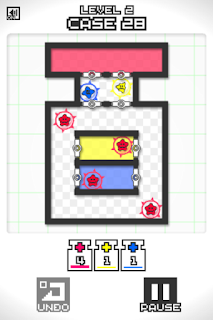 In some puzzles, there are also doors protected by a force field, which cannot be used until all viruses of that color have been killed.
 Finally, a puzzle game involving colors wouldn't be complete without a way to mix them. This is done using fans. Here you need to mix blue and yellow to get green.
 Fans can also be used simply to move gas from one room to another, as if you opened a door and immediately closed it again (which isn't possible with normal doors).
Solving these puzzles is enjoyable and requires finding the correct order that viruses need to be taken down while also allowing you to save some gas to kill the remaining ones. The solution often isn't unique, but in the hardest puzzles there is less freedom of choice.
There's a total of 100 puzzles, split across 5 difficulty levels. You start with 20 unlocked, and then every 10 puzzles solved, a new group of 10 is unlocked.
The puzzles vary in shape and size. The largest ones require precise touches on the iPhone's small screen, however if you make a mistake you can always use the undo button.

The price is currently $2.99, which I think is justified by the originality of the mechanics, however it dropped as low as $0.99 a few times since when the game was released in 2011.
If you want to try a free version first, there are actually two:
Vaccine Case LITE - 12 levels that show most of the mechanics of the full version.
Vacchine Case [headache] - 12 new, exceptionally hard levels. I solved only 1 of them!
©2013 Nicola Salmoria. Unauthorized use and/or duplication without express and written permission is strictly prohibited. Excerpts and links may be used, provided that full and clear credit is given to Nicola Salmoria and nontrivialgames.blogspot.com with appropriate and specific direction to the original content.

The basic idea is this: you see the map of a lab. Some rooms contain viruses, other rooms contain antidote gas. When gas comes in contact with a virus of the same color, both disappear. The goal is to remove all viruses.
To play the game, you control doors. The basic type of door can only be opened. When you open a door, gas spreads as far as it can go and cannot be stopped.


In a tradition common to other Japanese puzzles, many levels are shaped like animals, fruit, or other objects. This one is a jar. Also note that a few of the viruses have a shield surrounding them. This means that you have to hit them twice to kill them.
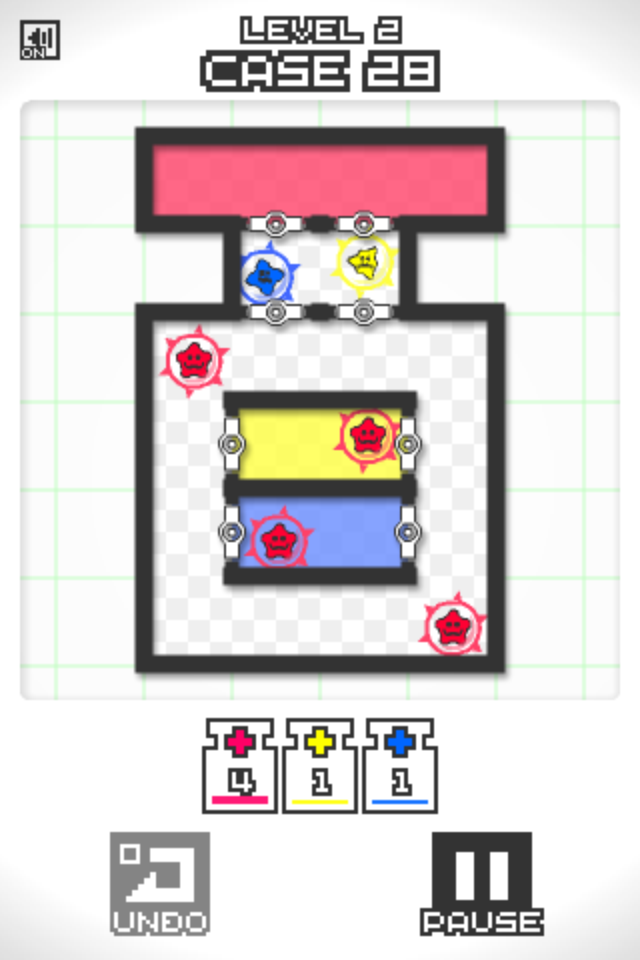


Solving these puzzles is enjoyable and requires finding the correct order that viruses need to be taken down while also allowing you to save some gas to kill the remaining ones. The solution often isn't unique, but in the hardest puzzles there is less freedom of choice.
There's a total of 100 puzzles, split across 5 difficulty levels. You start with 20 unlocked, and then every 10 puzzles solved, a new group of 10 is unlocked.
The puzzles vary in shape and size. The largest ones require precise touches on the iPhone's small screen, however if you make a mistake you can always use the undo button.

The price is currently $2.99, which I think is justified by the originality of the mechanics, however it dropped as low as $0.99 a few times since when the game was released in 2011.
If you want to try a free version first, there are actually two:
Vaccine Case LITE - 12 levels that show most of the mechanics of the full version.
Vacchine Case [headache] - 12 new, exceptionally hard levels. I solved only 1 of them!
Summary
| Nontrivialness | ★★★★★ |
| Logical Reasoning | ★★★★★ |
| User Interface | ★★★☆☆ |
| Presentation | ★★★☆☆ |
| Loading Time | ★★★★★ |
| Saves Partial Progress | ✘ |
| Status Bar | ✘ |
©2013 Nicola Salmoria. Unauthorized use and/or duplication without express and written permission is strictly prohibited. Excerpts and links may be used, provided that full and clear credit is given to Nicola Salmoria and nontrivialgames.blogspot.com with appropriate and specific direction to the original content.
Wednesday, May 1, 2013
Review: Solitaire Chess for iPhone and iPad
Solitaire Chess (also free) is the iPhone port of an excellent board puzzle made by ThinkFun. It was invented by Vesa Timonen, a finnish engineer who created many ingenious mechanical puzzles.
Tilt is another puzzle in the same line, which I think would work great on iPhone. Hopefully someday it will be ported.
 The basic idea is deceptively simple: put some traditional chess pieces on a 4x4 board, then use the normal chess rules to move one piece at a time. But here's the catch: for every move you make, you have to capture one piece. When only one piece remains, you have solved the puzzle.
 The above puzzle is easy enough, but things get trickier pretty soon.
You can use logic to rule out possibilities; also, it helps if you can figure out which piece should make the last move and reason backwards.
 For example in the above puzzle it's clear that if you moved the Knight at the top right, it would have nowhere to go and it could not be captured. So it must stay in its place and can only be captured by a Rook; it isn't hard to figure out what to do before then.
Note that the solution to this puzzle is not unique; this is a common occurrence in this game, however the last piece remaining and its position at the end of the puzzle are always unique.
Here is how the difficult puzzles look like. Having more pieces on the board makes it a lot harder to find the correct sequence of moves. With these longer move sequences, the undo button can be useful, though figuring out which piece to move first is probably the hardest part.
 This game is a bit old (it was released at the beginning of 2011) and it shows, because it doesn't support the Retina resolution.
The free version contains 40 puzzles, the pay version 400. The puzzles are excellent, but I think that by today's App Store standards, the pay version is a bit overpriced. Still, in objective terms, it's (much) less than 1 cent per puzzle. Try the free version first to be sure.
©2013 Nicola Salmoria. Unauthorized use and/or duplication without express and written permission is strictly prohibited. Excerpts and links may be used, provided that full and clear credit is given to Nicola Salmoria and nontrivialgames.blogspot.com with appropriate and specific direction to the original content.
Tilt is another puzzle in the same line, which I think would work great on iPhone. Hopefully someday it will be ported.


You can use logic to rule out possibilities; also, it helps if you can figure out which piece should make the last move and reason backwards.

Note that the solution to this puzzle is not unique; this is a common occurrence in this game, however the last piece remaining and its position at the end of the puzzle are always unique.
Here is how the difficult puzzles look like. Having more pieces on the board makes it a lot harder to find the correct sequence of moves. With these longer move sequences, the undo button can be useful, though figuring out which piece to move first is probably the hardest part.

The free version contains 40 puzzles, the pay version 400. The puzzles are excellent, but I think that by today's App Store standards, the pay version is a bit overpriced. Still, in objective terms, it's (much) less than 1 cent per puzzle. Try the free version first to be sure.
Summary
| Nontrivialness | ★★★★★ |
| Logical Reasoning | ★★★★☆ |
| User Interface | ★★★☆☆ |
| Presentation | ★★★☆☆ |
| Loading Time | ★★★★★ |
| Saves Partial Progress | ✔ |
| Status Bar | ✘ |
©2013 Nicola Salmoria. Unauthorized use and/or duplication without express and written permission is strictly prohibited. Excerpts and links may be used, provided that full and clear credit is given to Nicola Salmoria and nontrivialgames.blogspot.com with appropriate and specific direction to the original content.
Subscribe to:
Posts (Atom)