If you don't know SubaraCity you can check my review of the game here.
My highest score is 232,788,070 and you can check the final state of the board here. I am ranked 284 of a total of 153,279 players so I suppose I have a few tricks that some people don't, so I'll try to share them.

The best iPhone and iPad games for logic puzzles enthusiasts
Showing posts with label match-and-join. Show all posts
Showing posts with label match-and-join. Show all posts
Monday, July 6, 2015
Review: SubaraCity
Subaracity is a FREE "match-by-combining" game recommended by Nicola Salmoria @NSalmoria on his tweeter feed. Matching games in all their flavors is a venerable genre on the AppStore and one I am particularly fond of. The reason of their popularity in my opinion is that they tend to be casual games and perfect for mobile. Other good examples of match-by-combining games are: Stickets, Threes! and Triple Town. Triple Town is the most similar one to SubaraCity, but they play quite differently.


Sunday, February 9, 2014
Review: Threes! for iPhone and iPad
People who follow me on Twitter had already seen the heads-up about Threes!, the latest puzzle game by Sirvo LLC.
 I wasn't the only one to notice this game, since it quickly climbed to #1 in the App Store charts, proving to be a perfect casual game. But is it also a good game for readers of this blog?
Friday, January 17, 2014
Review: KAMI for iPhone and iPad
When I originally downloaded KAMI by State of Play Games, I wasn't particularly impressed so I left it aside for the time being. Maybe I'm in more of a zen mood now because I picked it up again and enjoyed it—though more for the presentation than for the puzzles themselves.
 The presentation is indeed gorgeous, which isn't surprising if you think that State of Play are the people behind the critically acclaimed Lume. As any origami folder knows, kami means paper in Japanese, and that's the theme of the game.
Saturday, January 4, 2014
Review: Comboline the Touch Action Puzzle for iPhone and iPad
Comboline (also free) is a match 3 game released in 2011 by the Italian indie studio Big Bang Pixel. Christian Costanza, the graphics and game designer, kindly sent me a promo code. He also had the honor of being the first person to reach 10th Dan in Zen Garden Puzzle, which is no small feat.
 I'm not much into match 3 games, especially timed ones, but I liked
the simplicity of this one: there are no silly powerups or other things
you can buy, it's just you and the tiles.
I'm not much into match 3 games, especially timed ones, but I liked
the simplicity of this one: there are no silly powerups or other things
you can buy, it's just you and the tiles.

Monday, October 14, 2013
Review: Shapes: A Colorful Challenge for iPhone and iPad
Shapes: A Colorful Challenge is not based on an original idea, but I like its simple mechanics. It would greatly benefit from better graphics, however.
 You start with an image composed of colored areas, some of which contain one or more balloons. When you tap a balloon, it disappears and transfers its color to the area it sits on. If adjacent areas have the same color, they merge. The goal is to end with the whole shape of a single color.

Wednesday, March 27, 2013
Review: Tile'm all for iPhone and iPad
Tile'm all by Dimitry Bogaevsky is an incredibly hard puzzle game for iPhone and iPad.
At first, it looks like just another sliding tile puzzle,
 but there is a clever variation, which I had never seen before: when two neighboring tiles are the same color, they merge, and from then on they can only move as a single piece.
The goal is to merge all pieces of the same color.
So in the puzzle above, if you move the green tile left you get into this position,
 which is already a lost position: continuing from here, you could for example merge the two yellow tiles and the two red tiles, but only leaving the green tiles split into two groups.
The game contains 119 levels. The first three are 3x3, all the others are 4x4.
Puzzle #4 is pretty difficult already.
 These puzzle feel claustrophobic, because every time two pieces are joined your movement options are reduced. Reaching the solution requires careful planning from the very first move, otherwise you'll inevitably end up blocked.
There's support for undo, but only of the last move, so to try different strategies you always have to restart from the beginning.
If you get stuck on a puzzle—and I guarantee that you will—there's a built-in hint system that allows to see a solved position (which is not necessarily the only one). Finding the moves to get there is still up to you, but knowing where the tiles need to go is a huge help.
The hint system is locked at the beginning and can be unlocked with a single in-app purchase. Once purchased, you can use it without limits. So be careful not to spoil the fun.
The user interface in this initial release is a bit rough and sluggish, detracting somewhat from the enjoyment of the game. For example, the movement of tiles while you drag them is a bit choppy.
The most serious shortcoming, however, is the puzzle selection list: you have to scroll puzzles one by one, with no trace of inertial scrolling, and they scroll horizontally instead of vertically. It works very differently from the standard iOS controls.
 I think the game would greatly benefit from using a master-detail layout like Lazors or Subaku.
The color scheme could also be improved for color blind people, here is the customary simulation of protanopia:
 My final worry is that all the puzzles have a similar checkerboard pattern. This is unavoidable because of the rules: at the beginning there can't be two tiles of the same color side by side, otherwise they would be merged immediately. This might make the puzzles feel repetitive after a while.
This game is highly recommended for its novel mechanics and frustrating difficulty. I hope the user interface will be significantly improved in future updates.
©2013 Nicola Salmoria. Unauthorized use and/or duplication without express and written permission is strictly prohibited. Excerpts and links may be used, provided that full and clear credit is given to Nicola Salmoria and nontrivialgames.blogspot.com with appropriate and specific direction to the original content.
At first, it looks like just another sliding tile puzzle,

The goal is to merge all pieces of the same color.
So in the puzzle above, if you move the green tile left you get into this position,

The game contains 119 levels. The first three are 3x3, all the others are 4x4.
Puzzle #4 is pretty difficult already.

There's support for undo, but only of the last move, so to try different strategies you always have to restart from the beginning.
If you get stuck on a puzzle—and I guarantee that you will—there's a built-in hint system that allows to see a solved position (which is not necessarily the only one). Finding the moves to get there is still up to you, but knowing where the tiles need to go is a huge help.
The hint system is locked at the beginning and can be unlocked with a single in-app purchase. Once purchased, you can use it without limits. So be careful not to spoil the fun.
The user interface in this initial release is a bit rough and sluggish, detracting somewhat from the enjoyment of the game. For example, the movement of tiles while you drag them is a bit choppy.
The most serious shortcoming, however, is the puzzle selection list: you have to scroll puzzles one by one, with no trace of inertial scrolling, and they scroll horizontally instead of vertically. It works very differently from the standard iOS controls.

The color scheme could also be improved for color blind people, here is the customary simulation of protanopia:

This game is highly recommended for its novel mechanics and frustrating difficulty. I hope the user interface will be significantly improved in future updates.
Summary
| Nontrivialness | ★★★★★ |
| Logical Reasoning | ★★★★☆ |
| User Interface | ★☆☆☆☆ |
| Presentation | ★★★☆☆ |
| Loading Time | ★★★★★ |
| Saves Partial Progress | ✔ |
| Status Bar | ✘ |
©2013 Nicola Salmoria. Unauthorized use and/or duplication without express and written permission is strictly prohibited. Excerpts and links may be used, provided that full and clear credit is given to Nicola Salmoria and nontrivialgames.blogspot.com with appropriate and specific direction to the original content.
Friday, February 22, 2013
Review: Pudding Monsters for iPhone and iPad
You probably don't need to learn from me about Pudding Monsters, a top quality game from Zeptolab, the makers of the classic Cut the Rope.
 The basic idea at the core of this puzzle game has been used before. You make the pudding monsters slide on the floor; once they start moving, they won't stop until they hit something. If they don't hit anything and leave the screen, you lose and have to start again.
 Even if the basic idea isn't new, I don't recall it having been used this way. When two monsters touch, they join to form a larger monster. The level is solved when all monsters are merged.
There is a lot of variety in the puzzles, because all kinds of different elements are introduced throughout the game: monsters that leave a sticky trail, sleeping monsters that cannot move until another monster joins with them, ice blocks that break after being hit, cloning machines, arrows, and so on.
Additionally, there's the customary three star rating system; stars are earned by finishing the level with monsters sitting on top of the stars.
The levels don't have a single solution, and after solving all levels for the first time, the game encourages you to play them again and earn 0, 1, 2 and 3 stars; when you do that, you earn a crown.
There are also funny Game Center achievements like "form a monster shaped like a hot dog".
Curiously, I've seen this game criticised both because it's "only" a logic game (by people that expected another action game like Cut the Rope) and because it is too easy as a logic game (by people that expected some hard core logic puzzle).
I don't think those criticisms are fair. Clearly, the first thing that strikes while playing the game is the incredible quality of the presentation: the animations are beautiful and full of humour, and the sound is great too. However the puzzles, while not terribly hard, can be challenging, especially if you want to earn all crowns. I've had many a-ha! moments when an elusive alternative solution finally clicked. Frankly, I don't think we could expect anything more than this from a game that is designed to sell millions of copies.
Every time I play, I'm amazed by the beauty of the level select screen. As you flick through the pages, the image in the background zooms out, sort of like in Powers of Ten™, starting from a cup of tea, through the roof of the house, to show the whole neighborhood (for now; it's easy to guess that we'll keep zooming out with future updates).
An update was released just today, adding 25 more levels, bringing the total to precisely 100. Even that way, and even playing each level multiple times to get the crown, it still feels a bit short, and you're left begging for more. But I think the main reason for this is that the game is so utterly enjoyable that you'd want to keep playing. Hopefully Zeptolab will continue to release updates in the future, like they did with Cut the Rope.
What do you think, is this game worthy of being labelled nontrivial?
©2013 Nicola Salmoria. Unauthorized use and/or duplication without express and written permission is strictly prohibited. Excerpts and links may be used, provided that full and clear credit is given to Nicola Salmoria and nontrivialgames.blogspot.com with appropriate and specific direction to the original content.

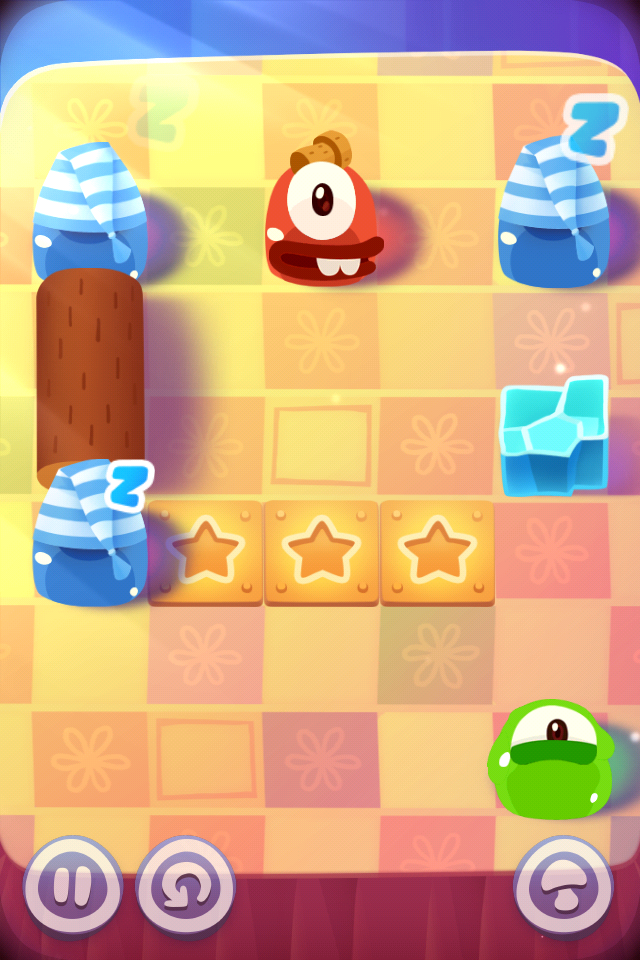
There is a lot of variety in the puzzles, because all kinds of different elements are introduced throughout the game: monsters that leave a sticky trail, sleeping monsters that cannot move until another monster joins with them, ice blocks that break after being hit, cloning machines, arrows, and so on.
Additionally, there's the customary three star rating system; stars are earned by finishing the level with monsters sitting on top of the stars.
The levels don't have a single solution, and after solving all levels for the first time, the game encourages you to play them again and earn 0, 1, 2 and 3 stars; when you do that, you earn a crown.
There are also funny Game Center achievements like "form a monster shaped like a hot dog".
Curiously, I've seen this game criticised both because it's "only" a logic game (by people that expected another action game like Cut the Rope) and because it is too easy as a logic game (by people that expected some hard core logic puzzle).
I don't think those criticisms are fair. Clearly, the first thing that strikes while playing the game is the incredible quality of the presentation: the animations are beautiful and full of humour, and the sound is great too. However the puzzles, while not terribly hard, can be challenging, especially if you want to earn all crowns. I've had many a-ha! moments when an elusive alternative solution finally clicked. Frankly, I don't think we could expect anything more than this from a game that is designed to sell millions of copies.
Every time I play, I'm amazed by the beauty of the level select screen. As you flick through the pages, the image in the background zooms out, sort of like in Powers of Ten™, starting from a cup of tea, through the roof of the house, to show the whole neighborhood (for now; it's easy to guess that we'll keep zooming out with future updates).
An update was released just today, adding 25 more levels, bringing the total to precisely 100. Even that way, and even playing each level multiple times to get the crown, it still feels a bit short, and you're left begging for more. But I think the main reason for this is that the game is so utterly enjoyable that you'd want to keep playing. Hopefully Zeptolab will continue to release updates in the future, like they did with Cut the Rope.
What do you think, is this game worthy of being labelled nontrivial?
Summary
| Nontrivialness | ★★★★☆ |
| Logical Reasoning | ★★★★☆ |
| User Interface | ★★★★★ |
| Presentation | ★★★★★ |
| Loading Time | ★★★☆☆ |
| Saves Partial Progress | ✘ |
| Status Bar | ✘ |
©2013 Nicola Salmoria. Unauthorized use and/or duplication without express and written permission is strictly prohibited. Excerpts and links may be used, provided that full and clear credit is given to Nicola Salmoria and nontrivialgames.blogspot.com with appropriate and specific direction to the original content.
Subscribe to:
Posts (Atom)