

The best iPhone and iPad games for logic puzzles enthusiasts
Showing posts with label placement. Show all posts
Showing posts with label placement. Show all posts
Sunday, October 19, 2014
Review: Pokergreen Puzzles for iPhone and iPad
Pokergreens is not quite "the next Sudoku", as its author Ronald Stewart calls it, but it successfully manages to mix the mechanics of classic pen-and-paper puzzles with the rules of poker.
This is the kind of puzzle game that was common in the early days of the App Store: a simple, lackluster user interface, but very clever mechanics. It reminded me of games like CounterbalancE and Combination, which I reviewed when I started this blog.

Sunday, September 28, 2014
Review: The Weaver for iPhone and iPad
The other day I noticed the polished icon of The Weaver among the new releases, and I was thrilled to see that it was developed by the Portuguese Pyrosphere.
 Pyrosphere might not be as well known as other big names in the industry, but I think it is one of the best developers of puzzle games in the world. I've reviewed other great games by them in the past: Lazors, Chess Light, and Bloom Box.
I wasn't disappointed; The Weaver is excellent, and I couldn't stop playing until I had almost finished it.
I wasn't disappointed; The Weaver is excellent, and I couldn't stop playing until I had almost finished it.
Monday, May 12, 2014
Review: Find Figure for iPhone and iPad
A couple of weeks ago I tweeted about Find Figure by Art Studio Dereza. Currently I'm not updating this blog as often as I would like to, but I talk about interesting new games on Twitter first, so make sure to follow me to be up to date with puzzle games news.
 I find that my mind takes particular enjoyment in puzzles that require visual-spatial ability. This tends to show in the games I develop, especially in Twin Beams, a difficult puzzle which however can be solved at ridiculously high speeds if one just looks for visual patterns. Find Figure is a lot easier, but it's also more complex than it might look at first sight.
Friday, April 4, 2014
Update: Lazors 2.3
The beautiful Lazors has been updated again, adding a new type of block, the Portal!
 The new block does what you would expect from any well behaved portal.
Friday, March 14, 2014
Review: Impuzzible - Monochromatic Rectangles Puzzle for iPhone and iPad
If you want to play hands-on with a complex mathematical problem, look no further than Impuzzible - Monochromatic Rectangles Puzzle.
 The stated goal is pretty simple: change the color of the blocks (choosing among four colors) in such a way that there are no
rectangles whose four corners have the same color. The grids get increasingly larger, so how far can you go before giving up?
The stated goal is pretty simple: change the color of the blocks (choosing among four colors) in such a way that there are no
rectangles whose four corners have the same color. The grids get increasingly larger, so how far can you go before giving up?
Wednesday, March 12, 2014
Zen Garden Puzzle: Three Moves Suffice
Today it's three months since the release of my last game Zen Garden Puzzle. While financially it has been a failure, and is orders of magnitude away from recovering the development costs, it has been appreciated by players, receiving nothing but 5-star reviews on the App Store.
A few people have been engaged enough to solve hundreds of puzzles, but only a handful have reached the elusive 10th Dan achivement. To earn that achievement, you have to take advantage of one of the selling points mentioned in the App Store blurb: "no matter what you do, you will never be more than three moves away from the puzzle's only solution."
After seeing the game for the first time, most people doubt that this is actually possible. Some asked me if you need some amount of luck to be able to do so. The answer is: it's always possible, and you don't need any luck, only skill. I could provide a mathematical proof, but I don't want to be more boring than usual, so I'll just show how to solve one puzzle.

A few people have been engaged enough to solve hundreds of puzzles, but only a handful have reached the elusive 10th Dan achivement. To earn that achievement, you have to take advantage of one of the selling points mentioned in the App Store blurb: "no matter what you do, you will never be more than three moves away from the puzzle's only solution."
After seeing the game for the first time, most people doubt that this is actually possible. Some asked me if you need some amount of luck to be able to do so. The answer is: it's always possible, and you don't need any luck, only skill. I could provide a mathematical proof, but I don't want to be more boring than usual, so I'll just show how to solve one puzzle.
Sunday, February 23, 2014
Review: Chess Light for iPhone and iPad
Chess Light's elegant icon caught my eye while I was browsing the new releases. When I saw that it was developed by Pyrosphere, the makers of the excellent Lazors, I immediately bought it.
 I'm a freak for games with elegant user interfaces. I loved Bézier, which looks like a physics textbook, but Chess Light might be even better. Everything from the font to the subtle color palette makes you think of a serious chess book.
Thursday, December 26, 2013
Review: Sifar for iPhone and iPad
Sifar by Takahiro Sakuda is a game in the tradition of Japanese logic puzzles.
 Interestingly, it would have worked as a
pen and paper puzzle, and the rules are simple enough that I wondered if it had been published before,
but couldn't find any prior art.
Interestingly, it would have worked as a
pen and paper puzzle, and the rules are simple enough that I wondered if it had been published before,
but couldn't find any prior art.

Thursday, December 12, 2013
Announcement: Zen Garden Puzzle for iPhone and iPad
My new game, Zen Garden Puzzle, is now available on the App Store!
 You've probably already seen the video, so let's talk in more detail about the mechanics.

Monday, December 9, 2013
Review: Atoms Puzzle for iPhone and iPad
It took me a while to fully grasp the rules of Atoms Puzzle by Wharf Games.
 It's not that they are difficult, but to play knowledgeably it's essential to have an exact understanding of the value of each piece on the board. The game however avoids showing clear numbers, relying only on the size of the pieces.

Tuesday, September 24, 2013
Review: Help Me Fly for iPhone and iPad
Help Me Fly by Funtomic is a casual puzzle game whose difficulty level pleasantly surprised me.
 The primary goal of the game is to rearrange the position of the red pieces, forming a continuous path from the battery to the plane. The secondary goal is to also connect the path to the stars (the number of stars changes from puzzle to puzzle). When you solve a puzzle, you get a nice animation of the plane flying away in circles.


Friday, September 6, 2013
Review: FlowDoku for iPhone and iPad
Just when you thought that Sudoku had been beaten to death, here comes FlowDoku by HapaFive Games, which turns the concept on its head to produce an excitingly original new puzzle.
 To be clear, the only thing this game shares with Sudoku is the basic premise of placing symbols on a grid so that certain requirements are met on every row, column, and box. That's pretty much the end of similarities.
In Sudoku you have 9 different symbols, which must not be repeated; in FlowDoku, you have a smaller number of symbols, some of which must be repeated a given number of times.


In Sudoku you have 9 different symbols, which must not be repeated; in FlowDoku, you have a smaller number of symbols, some of which must be repeated a given number of times.

Tuesday, August 27, 2013
Review: Reiner Knizia's Kaleidoscope for iPhone and iPad
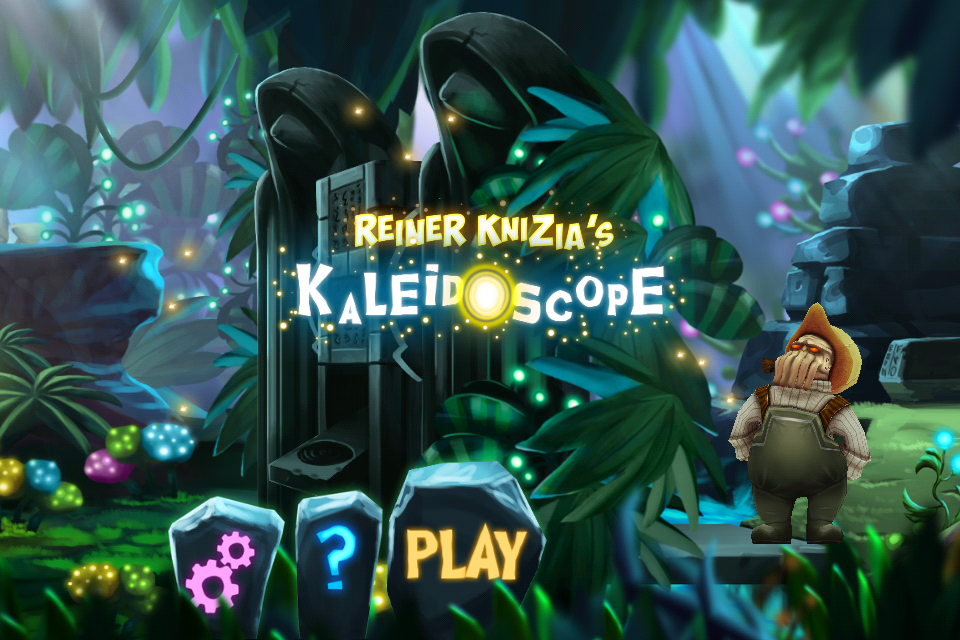
Reiner Knizia's Kaleidoscope is a nice variation of domino placement puzzles, flawed by a mediocre user interface.
 Whether Reiner Knizia was actually involved in the design of these puzzles, or
his name is just used for marketing purposes, is unclear to me. The game uses the same double-hexagon domino pieces of Knizia's Ingenious (marketed as Kaleidoskop in some countries), but that's a totally different game.
Whether Reiner Knizia was actually involved in the design of these puzzles, or
his name is just used for marketing purposes, is unclear to me. The game uses the same double-hexagon domino pieces of Knizia's Ingenious (marketed as Kaleidoskop in some countries), but that's a totally different game.
Wednesday, August 21, 2013
Update: Lazors 2.2
An update to the popular Lazors was released a few days ago, featuring 5 new groups of puzzles with cleverly thought themes, for a total of 50 new puzzles.
Numbered features grids shaped like the numbers 1 to 10, and each puzzle even has a matching number of blocks!

Numbered features grids shaped like the numbers 1 to 10, and each puzzle even has a matching number of blocks!

Saturday, July 20, 2013
Strategy Guide: Stickets
Lately I've been not only playing Stickets a lot, but also thinking about it as an example of a very well designed game.
 Just a few days ago, Raf Peeters was kind enough to share with me some insight about how puzzles which are enjoyable in physical form don't necessarily work as well when ported to a touch screen device. For example, a put-together puzzle like Roadblock becomes harder to play on iPhone because rotating the pieces, which is a natural motion when playing the physical version, becomes cumbersome and requires multiple taps.
Stickets doesn't have the above problem, because it was born as a digital game. It avoids the difficulty of rotating the pieces, simply by not allowing to rotate them. Everything becomes more natural that way.

Stickets doesn't have the above problem, because it was born as a digital game. It avoids the difficulty of rotating the pieces, simply by not allowing to rotate them. Everything becomes more natural that way.
Tuesday, June 18, 2013
Review: Stickets for iPhone and iPad
Match 3 puzzle games are a dime a dozen on the App Store. I don't find them particularly interesting, and usually stay well clear of them.
Stickets, however, is pretty darn good. It is highly original, exceptionally polished, and bloody hard.
 Stickets is the lastest game released by the Australian developer Wanderlands. One of their earlier creations is the brilliant Impasse, which is currently only available as a Flash game. Sadly, it is so good that it has been unofficially ported multiple times to iPhone, and I even reviewed one of those copycats a few weeks ago, not knowing that it wasn't an original game (don't look for that review now, I've removed it).
Stickets, however, is pretty darn good. It is highly original, exceptionally polished, and bloody hard.

Monday, June 10, 2013
Update: Fields 1.0.4
Fields by Kevin Langdon has just been updated and it addressed the criticism I made in my previous review.
 In its first release the game showed a lot of potential: the flower theme fits perfectly the mechanics of the puzzles. Unfortunately, I was disappointed that some puzzles didn't have a unique solution. I'm happy to see that this issue has been fully fixed in the update.
 There are 100 new puzzles to solve, and two extra packs of 100 puzzles of size 4x5 and 5x6 that can be unlocked through in-app purchases. Hopefully more packs at larger sizes will be available in a future update.
Now that the puzzles have a unique solution, they are a joy to solve. I wish the user interface were just a bit smoother in the transitions, but apart from that the game is strongly recommended.
©2013 Nicola Salmoria. Unauthorized use and/or duplication without express and written permission is strictly prohibited. Excerpts and links may be used, provided that full and clear credit is given to Nicola Salmoria and nontrivialgames.blogspot.com with appropriate and specific direction to the original content.


Now that the puzzles have a unique solution, they are a joy to solve. I wish the user interface were just a bit smoother in the transitions, but apart from that the game is strongly recommended.
©2013 Nicola Salmoria. Unauthorized use and/or duplication without express and written permission is strictly prohibited. Excerpts and links may be used, provided that full and clear credit is given to Nicola Salmoria and nontrivialgames.blogspot.com with appropriate and specific direction to the original content.
Friday, June 7, 2013
Review: Bloom Box for iPhone and iPad
Bloom Box took me by surprise. Seeing that it was advertised on the home page of Touch Arcade, I expected it to be entirely targeted at casual gamers, but its mechanics are actually quite good.
What intrigued me was the last sentence of the app description: "In collaboration with Pyrosphere".
Pyrosphere is the developer of the excellent Lazors, so that was certainly a good start.
Indeed, after some research, it turns out that this release by Nexx Studio is a remake, with better graphics, of a game with the same title that Pyrosphere released in 2011. The original game is no longer available on the App Store.
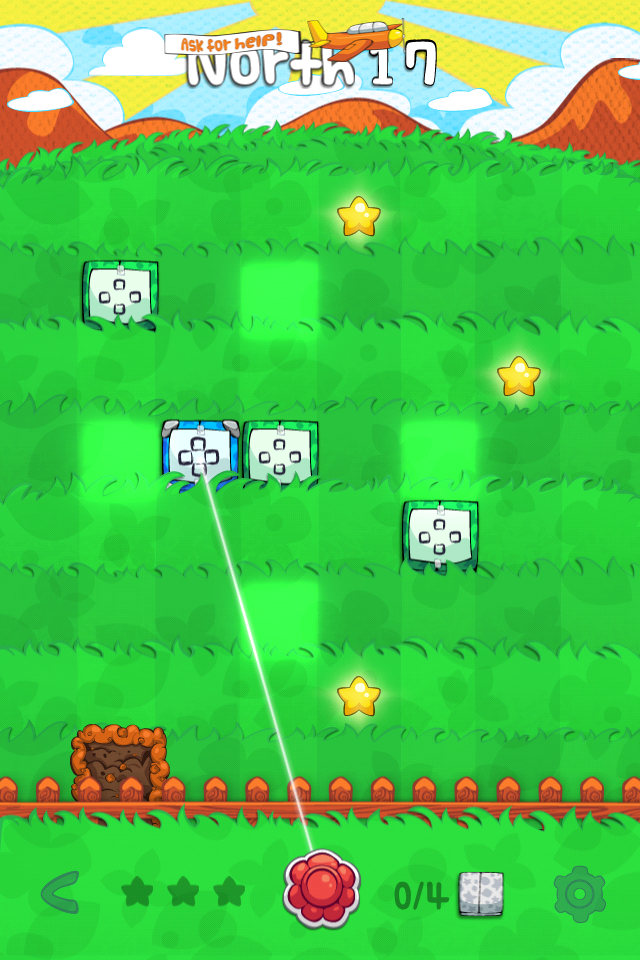
 The playing area is an 8x8 grid representing a garden. In the garden there are a few boxes, most of which can be moved around. One of the boxes cannot be moved and is connected by a white line to a button at the bottom of the screen. When you tap the button, a drop will be shot toward the box, and the box will explode, shooting more drops on nearby tiles. If those drops hit other boxes, they'll explode too, causing a chain reaction.
To solve a puzzle you just need to hit all the boxes, but to solve it properly you also need to hit three stars. There can be multiple ways to do it.
 Note also that there are holes in the garden. You can't put a box over those tiles.
The labels on the boxes indicate which tiles they hit when they explode. Initially you play with blue and red boxes, which shoot orthogonally and diagonally.
Later, green boxes appear, which shoot orthogonally but 2 tiles away. Helpfully, when you drag a box the tiles targeted by it are highlighted.
 Further into the game, you find purple boxes, which shoot like the Knight moves in chess.
 I haven't solved all puzzles yet so there might be even more box types to see.
The puzzles are well designed and even with a small number of boxes, the solution can be counterintuitive and elusive. Logic helps a lot in weeding out impossible arrangements and isolate the solution.
There are currently 120 puzzles, split across three "gardens" plus a "Star Garden". The levels in the three gardens are unlocked in sequence, and the ones in the Star Garden are unlocked one by one when you earn enough stars. The Star Garden puzzles are apparently supposed to be slightly harder than the others.
The puzzles in this game aren't very difficult, but they aren't trivial either, and I found them to be very fun. It's definitely worth a try; there is also a free version available.
©2013 Nicola Salmoria. Unauthorized use and/or duplication without express and written permission is strictly prohibited. Excerpts and links may be used, provided that full and clear credit is given to Nicola Salmoria and nontrivialgames.blogspot.com with appropriate and specific direction to the original content.
What intrigued me was the last sentence of the app description: "In collaboration with Pyrosphere".
Pyrosphere is the developer of the excellent Lazors, so that was certainly a good start.
Indeed, after some research, it turns out that this release by Nexx Studio is a remake, with better graphics, of a game with the same title that Pyrosphere released in 2011. The original game is no longer available on the App Store.

To solve a puzzle you just need to hit all the boxes, but to solve it properly you also need to hit three stars. There can be multiple ways to do it.

The labels on the boxes indicate which tiles they hit when they explode. Initially you play with blue and red boxes, which shoot orthogonally and diagonally.
Later, green boxes appear, which shoot orthogonally but 2 tiles away. Helpfully, when you drag a box the tiles targeted by it are highlighted.

The puzzles are well designed and even with a small number of boxes, the solution can be counterintuitive and elusive. Logic helps a lot in weeding out impossible arrangements and isolate the solution.
There are currently 120 puzzles, split across three "gardens" plus a "Star Garden". The levels in the three gardens are unlocked in sequence, and the ones in the Star Garden are unlocked one by one when you earn enough stars. The Star Garden puzzles are apparently supposed to be slightly harder than the others.
The puzzles in this game aren't very difficult, but they aren't trivial either, and I found them to be very fun. It's definitely worth a try; there is also a free version available.
Summary
| Nontrivialness | ★★★☆☆ |
| Logical Reasoning | ★★★★☆ |
| User Interface | ★★★☆☆ |
| Presentation | ★★★☆☆ |
| Loading Time | ★★★★★ |
| Saves Partial Progress | ✘ |
| Status Bar | ✘ |
©2013 Nicola Salmoria. Unauthorized use and/or duplication without express and written permission is strictly prohibited. Excerpts and links may be used, provided that full and clear credit is given to Nicola Salmoria and nontrivialgames.blogspot.com with appropriate and specific direction to the original content.
Saturday, May 18, 2013
Review: Takuzu for iPhone and iPad
Takuzu is a fake Japanese sounding name for a puzzle that has often been described as "binary Sudoku" (even if it's quite different from Sudoku). Indeed, it is also known as Binairo, or simply as Binary Puzzle.
It is played on a square grid of variable size; the iPhone version supports from 4x4 to 8x8, while the iPad version from 6x6 to 12x12.
 The rules are:
1) Each row and column must contain the same number of 0s and 1s
2) There can be no more than two consecutive 0s or 1s.
3) There cannot be two identical rows or columns.
Rule 3) is not intuitive and is often unnecessary.
I didn't find the puzzles particularly enjoyable. The easiest ones felt like mechanical applications of the basic tips, which are trivial corollaries of the rules. In the harder ones, I got often stuck with no apparent way to proceed through logic deductions, the only way forward being to make a guess.
Of course I might have missed something, however it doesn't look like this puzzle has enough depth to provide lasting appeal.
The game generates the puzzles randomly; when you want to add a new one to the list, you select the size and difficulty (from 3 levels). Puzzles in progress are diligently stored and you can go back to them at any time.
 I don't like the random generation. In this kind of games, random generation usually doesn't provide
enjoyable puzzles; a careful selection process is needed to pick only the interesting
puzzles.
I don't like the random generation. In this kind of games, random generation usually doesn't provide
enjoyable puzzles; a careful selection process is needed to pick only the interesting
puzzles.
The first 50 puzzles are free, so give this one a try if you think the mechanics are interesting.
©2013 Nicola Salmoria. Unauthorized use and/or duplication without express and written permission is strictly prohibited. Excerpts and links may be used, provided that full and clear credit is given to Nicola Salmoria and nontrivialgames.blogspot.com with appropriate and specific direction to the original content.
It is played on a square grid of variable size; the iPhone version supports from 4x4 to 8x8, while the iPad version from 6x6 to 12x12.

1) Each row and column must contain the same number of 0s and 1s
2) There can be no more than two consecutive 0s or 1s.
3) There cannot be two identical rows or columns.
Rule 3) is not intuitive and is often unnecessary.
I didn't find the puzzles particularly enjoyable. The easiest ones felt like mechanical applications of the basic tips, which are trivial corollaries of the rules. In the harder ones, I got often stuck with no apparent way to proceed through logic deductions, the only way forward being to make a guess.
Of course I might have missed something, however it doesn't look like this puzzle has enough depth to provide lasting appeal.
The game generates the puzzles randomly; when you want to add a new one to the list, you select the size and difficulty (from 3 levels). Puzzles in progress are diligently stored and you can go back to them at any time.

The first 50 puzzles are free, so give this one a try if you think the mechanics are interesting.
Summary
| Nontrivialness | ★★★☆☆ |
| Logical Reasoning | ★★★☆☆ |
| User Interface | ★★★☆☆ |
| Presentation | ★★☆☆☆ |
| Loading Time | ★★★☆☆ |
| Saves Partial Progress | ✔ |
| Status Bar | ✔ |
©2013 Nicola Salmoria. Unauthorized use and/or duplication without express and written permission is strictly prohibited. Excerpts and links may be used, provided that full and clear credit is given to Nicola Salmoria and nontrivialgames.blogspot.com with appropriate and specific direction to the original content.
Thursday, May 9, 2013
Review: Cubo di Coppo for iPhone and iPad
Cubo di Coppo is Italian for "Coppo's Cube"; Eugenio Coppo being the name of the Italian architect who invented it (as an aside, I like his sculptures too).
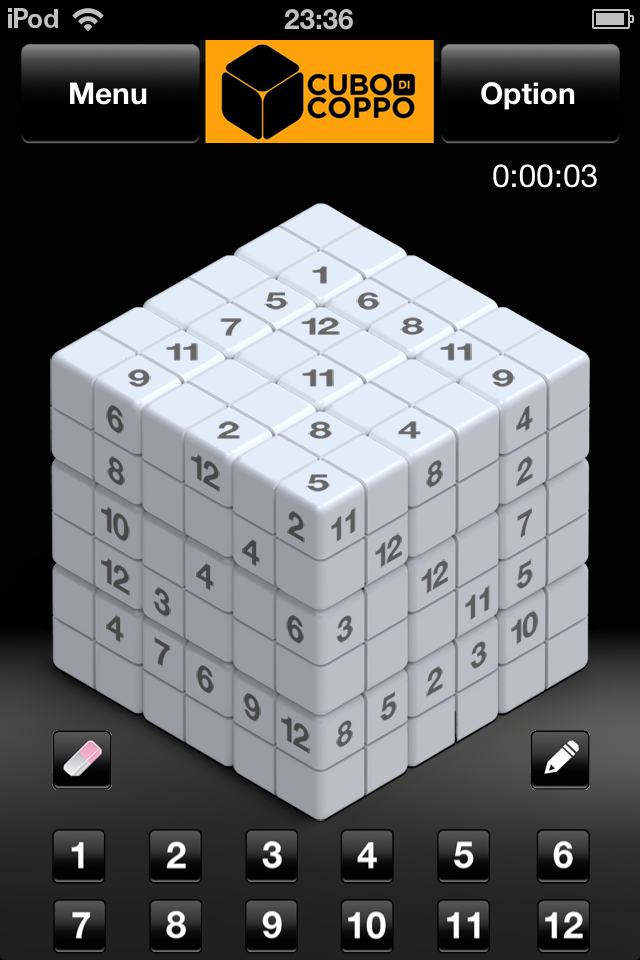
The game resembles Sudoku, but is played on three faces of a cube.
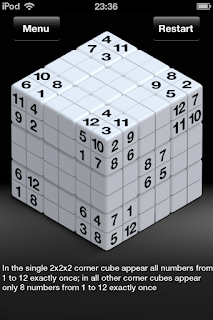
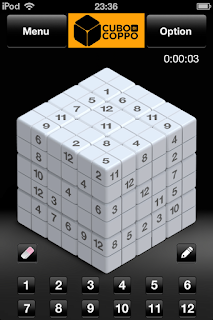 The rules are a bit more complicated than Sudoku, and are difficult to explain briefly with words, so let me use the game's built-in instructions (click the images to enlarge them):


 The iPhone's screen is a bit too small to play the game comfortably,
and it's difficult to tap the cell you want to select. This could
probably be improved with the addition of zoom support. In the meantime,
an iPad is recommended.
The iPhone's screen is a bit too small to play the game comfortably,
and it's difficult to tap the cell you want to select. This could
probably be improved with the addition of zoom support. In the meantime,
an iPad is recommended.
Due to the higher number of cells and values, these puzzles are harder to solve than Sudoku; not necessarily because they require more complex reasoning, but simply because it is more difficult to visually scan the playing area. I found them tiring more than enjoyable; but bear in mind that I can't stand Sudoku anymore, so I'm a bit negatively biased..
If you still like Sudoku, you might enjoy this game. If you want to give the puzzles a try before buying it, there are a few printable samples on the official site.
©2013 Nicola Salmoria. Unauthorized use and/or duplication without express and written permission is strictly prohibited. Excerpts and links may be used, provided that full and clear credit is given to Nicola Salmoria and nontrivialgames.blogspot.com with appropriate and specific direction to the original content.
The game resembles Sudoku, but is played on three faces of a cube.


Due to the higher number of cells and values, these puzzles are harder to solve than Sudoku; not necessarily because they require more complex reasoning, but simply because it is more difficult to visually scan the playing area. I found them tiring more than enjoyable; but bear in mind that I can't stand Sudoku anymore, so I'm a bit negatively biased..
If you still like Sudoku, you might enjoy this game. If you want to give the puzzles a try before buying it, there are a few printable samples on the official site.
Summary
| Nontrivialness | ★★★★☆ |
| Logical Reasoning | ★★★★★ |
| User Interface | ★★★☆☆ |
| Presentation | ★★★★☆ |
| Loading Time | ★★★★★ |
| Saves Partial Progress | ✘ |
| Status Bar | ✔ |
©2013 Nicola Salmoria. Unauthorized use and/or duplication without express and written permission is strictly prohibited. Excerpts and links may be used, provided that full and clear credit is given to Nicola Salmoria and nontrivialgames.blogspot.com with appropriate and specific direction to the original content.
Subscribe to:
Posts (Atom)