What best time to talk about a game about love than... Halloween?
Surely Fallin Love will have a big promotion for Valentine's Day, however an update was released recently, featuring new levels and significantly improved performance on older devices, so it's worth talking about it now.
Technically, this game by the Italian Chestnut Games should be considered an action game: a platformer, where the usual ability to jump has been replaced by tilt mechanics. However, the action elements are minimal, and it plays more like a puzzle game.
Showing posts with label tilt. Show all posts
Saturday, November 1, 2014
Monday, June 16, 2014
Review: SpinIn for iPhone and iPad
SpinIn (also for iPad) by Klogia is a new release but looks old—and for good reason.
Confused by the splash screen? Well, don't worry. The actual game looks nothing like that. Actually, there is no "Spin" mechanic at all! Instead, it's a "Tilt" maze.
Labels:
maze,
sequential movement,
tilt
Tuesday, May 27, 2014
Review: Kuub for iPhone and iPad
Kuub by Wim Coosemans is a well designed tilt maze puzzle on the vein of Blockhouse.
Tile mazes are a well estabilished genre, and Kuub succeeds in adding new elements and ideas to keep the mechanics fresh and stimulating.
Wednesday, April 9, 2014
A Visual Catalog of Threes! Clones
If you follow gaming news, you have probably read about the big drama spurred by the developers of Threes!, who posted a detailed history of the development of their game, to show how long it took them to create it, compared to how quickly it was copied. It's a very interesting read, especially if you are a game designer, so I'd encourage everyone to take a look at it. Threes might look simple, but the process that bought to its final state was far from simple.
The one thing I don't like about this story is how all the attention has been put on 2048, calling it a rip-off of Threes. This post was initially going to be about how I don't agree with that, but attempting to prove my point I turned it into a collection of real clones of Threes, so I'll focus on those for now and talk about 2048 another time.
![]() |
| Threes!, released February 6th |
Labels:
clones,
match-and-vanish,
merging,
numbers,
tilt
Sunday, February 9, 2014
Review: Threes! for iPhone and iPad
People who follow me on Twitter had already seen the heads-up about Threes!, the latest puzzle game by Sirvo LLC.
I wasn't the only one to notice this game, since it quickly climbed to #1 in the App Store charts, proving to be a perfect casual game. But is it also a good game for readers of this blog?
Labels:
match-and-join,
merging,
numbers,
tilt
Monday, December 16, 2013
Review: MindTilt for iPhone and iPad
MindTilt by MadRuse Games is a 3D puzzle game that I really wanted to like. I came back to it several times with the best intentions, but eventually I gave up.
MindTilt is a tilt maze, by which I mean that everything which isn't nailed down moves in the same direction until it hits a wall or something else. I've played a few others in the past (the best is probably still Blockhouse), but this is the first time I see one in full 3D.
Saturday, March 9, 2013
Review: Blockhouse for iPhone and iPad
Blockhouse is an old puzzle game by Kory Heath which was released in 2009. It's a classic, so if you missed it back then, it's not too late to check it out.
There's also a free version, Blockhouse Lite, which contains different puzzles, so it's worth getting it even if you buy the full version.
The game mechanics aren't new, and weren't new when Blockhouse was released, either. It's a tilt maze: swipe in one direction, and all blocks move in that direction until they hit something. The goal is to move every piece to a specified target position.
What makes this game stand out from the crowd, however, is variety. There are a few different kinds of puzzles, for example there are open spaces with complex polyominoes:
There are large mazes with square pieces—and being who I am, I can't restrain myself from showing the tribute to Pac-Man:
There are small, separated mazes:
And so on.
Note that just passing over the target position isn't enough: every piece must stop exactly on the target, at the same time. This requires some planning, and it's definitely unlikely to stumble on the solution by accident. Hint: it is often easier to solve the puzzles by mentally going backwards from the goal position.
Kory Heath wrote a very informative post about how he created this game. It's a goldmine of information for people interested in what it takes to make a nontrivial game. This is definitely not one of those characterless, randomly generated puzzle collections.
A great feature, unusual for tilt puzzles, is that it is impossible to get stuck in an unsolvable position. No matter what you do, it's always possible to reach the goal. This reduces stress and encourages random tinkering during the early stages of a puzzle; but you will have to use your brain to solve it.
There's only one bad part in this story: Kory Heath hasn't had time to make Blockhouse 2.
But there is still hope, I guess.
©2013 Nicola Salmoria. Unauthorized use and/or duplication without express and written permission is strictly prohibited. Excerpts and links may be used, provided that full and clear credit is given to Nicola Salmoria and nontrivialgames.blogspot.com with appropriate and specific direction to the original content.
There's also a free version, Blockhouse Lite, which contains different puzzles, so it's worth getting it even if you buy the full version.
The game mechanics aren't new, and weren't new when Blockhouse was released, either. It's a tilt maze: swipe in one direction, and all blocks move in that direction until they hit something. The goal is to move every piece to a specified target position.
What makes this game stand out from the crowd, however, is variety. There are a few different kinds of puzzles, for example there are open spaces with complex polyominoes:
There are large mazes with square pieces—and being who I am, I can't restrain myself from showing the tribute to Pac-Man:
There are small, separated mazes:
And so on.
Note that just passing over the target position isn't enough: every piece must stop exactly on the target, at the same time. This requires some planning, and it's definitely unlikely to stumble on the solution by accident. Hint: it is often easier to solve the puzzles by mentally going backwards from the goal position.
Kory Heath wrote a very informative post about how he created this game. It's a goldmine of information for people interested in what it takes to make a nontrivial game. This is definitely not one of those characterless, randomly generated puzzle collections.
A great feature, unusual for tilt puzzles, is that it is impossible to get stuck in an unsolvable position. No matter what you do, it's always possible to reach the goal. This reduces stress and encourages random tinkering during the early stages of a puzzle; but you will have to use your brain to solve it.
There's only one bad part in this story: Kory Heath hasn't had time to make Blockhouse 2.
But there is still hope, I guess.
Summary
| Nontrivialness | ★★★★☆ |
| Logical Reasoning | ★★★★☆ |
| User Interface | ★★★★☆ |
| Presentation | ★★★★☆ |
| Loading Time | ★★★★☆ |
| Saves Partial Progress | ✔ |
| Status Bar | ✘ |
©2013 Nicola Salmoria. Unauthorized use and/or duplication without express and written permission is strictly prohibited. Excerpts and links may be used, provided that full and clear credit is given to Nicola Salmoria and nontrivialgames.blogspot.com with appropriate and specific direction to the original content.
Saturday, March 2, 2013
Review: Tile Drop for iPhone and iPad
The other day I stumbled by accident on Tile Drop, a nice free puzzle game for iPhone and iPad by Daniel Wood.
The basic idea isn't new, and actually there's an interesting story behind.
The mechanics of Tile Drop are the same of another game by the same author, Blockees.
Blockees itself was a remake of Blockee by Rob Gibson. Both games are no longer available on the App Store.
Blockee was inspired by Eliminator by Riza Purwo Nugroho, which brings us to Jakarta, Indonesia, back in 2002 at least.
This new incarnation of the game is a beautiful implementation, featuring an excellent minimalistic interface, possibly inspired by Letterpress - Word Game. Static images wouldn't do it justice so I invite you to take a look at the promo video:
As you can see the rules are simple. There's a 5x5 board containing some colored tiles.
When you swipe the screen, all tiles move in that direction until they hit the side of the screen or another tile. Black tiles don't move.
When two or more tiles of the same color touch, they disappear. Grey tiles don't disappear. The goal is to remove all coloured tiles.
And, you must do it in exactly the optimal number of moves. No discounts.
The puzzles included range from easy ones requiring just 2 moves, to very hard ones requiring 10 moves. I like how the size of the board remains fixed at 5x5 and the difficulty is only determined by the layout. Here's one requiring 10 moves.
10 moves is pretty damn hard, and I don't think logical reasoning would get us far enough. The tile layout can change a lot with every move, so it's quite difficult to keep a mental image. This is really a game that needs to be interacted with, and the experience can be almost hypnotical, furiously trying different strategies and reaching for the reset button every time they fail.
One thing to note is that the optimal solution isn't guaranteed to be unique: I've seen several puzzles that could be completed in multiple ways.
As you can see in the image above, there's an option to get hints when you are solidly stuck. They can be bought through in-app purchases, but the game also awards them liberally.
The way how you progress through the game is peculiar. After unlocking the option, you can simply generate new packs containing 10 puzzles of a given difficulty. The packs are randomly generated from a database which, according to the author, currently contains over 3,000 puzzles.
The puzzle database is actually fueled by users of the game. There's a built-in editor which is very easy to use and allows to share your creations with the other players (getting hints in return). This might actually be a weakness of the game, because there will be no quality control over the user generated puzzles, which might result in most of the puzzles being boring when compared to the ones created by the game's author.
Nevertheless, this is a solidly fun and extremely polished game, which deserves to be experienced.
©2013 Nicola Salmoria. Unauthorized use and/or duplication without express and written permission is strictly prohibited. Excerpts and links may be used, provided that full and clear credit is given to Nicola Salmoria and nontrivialgames.blogspot.com with appropriate and specific direction to the original content.
The basic idea isn't new, and actually there's an interesting story behind.
The mechanics of Tile Drop are the same of another game by the same author, Blockees.
Blockees itself was a remake of Blockee by Rob Gibson. Both games are no longer available on the App Store.
Blockee was inspired by Eliminator by Riza Purwo Nugroho, which brings us to Jakarta, Indonesia, back in 2002 at least.
This new incarnation of the game is a beautiful implementation, featuring an excellent minimalistic interface, possibly inspired by Letterpress - Word Game. Static images wouldn't do it justice so I invite you to take a look at the promo video:
As you can see the rules are simple. There's a 5x5 board containing some colored tiles.
When you swipe the screen, all tiles move in that direction until they hit the side of the screen or another tile. Black tiles don't move.
When two or more tiles of the same color touch, they disappear. Grey tiles don't disappear. The goal is to remove all coloured tiles.
And, you must do it in exactly the optimal number of moves. No discounts.
The puzzles included range from easy ones requiring just 2 moves, to very hard ones requiring 10 moves. I like how the size of the board remains fixed at 5x5 and the difficulty is only determined by the layout. Here's one requiring 10 moves.
10 moves is pretty damn hard, and I don't think logical reasoning would get us far enough. The tile layout can change a lot with every move, so it's quite difficult to keep a mental image. This is really a game that needs to be interacted with, and the experience can be almost hypnotical, furiously trying different strategies and reaching for the reset button every time they fail.
One thing to note is that the optimal solution isn't guaranteed to be unique: I've seen several puzzles that could be completed in multiple ways.
As you can see in the image above, there's an option to get hints when you are solidly stuck. They can be bought through in-app purchases, but the game also awards them liberally.
The way how you progress through the game is peculiar. After unlocking the option, you can simply generate new packs containing 10 puzzles of a given difficulty. The packs are randomly generated from a database which, according to the author, currently contains over 3,000 puzzles.
The puzzle database is actually fueled by users of the game. There's a built-in editor which is very easy to use and allows to share your creations with the other players (getting hints in return). This might actually be a weakness of the game, because there will be no quality control over the user generated puzzles, which might result in most of the puzzles being boring when compared to the ones created by the game's author.
Nevertheless, this is a solidly fun and extremely polished game, which deserves to be experienced.
Summary
| Nontrivialness | ★★★★☆ |
| Logical Reasoning | ★★★☆☆ |
| User Interface | ★★★★☆ |
| Presentation | ★★★★★ |
| Loading Time | ★★★★☆ |
| Saves Partial Progress | ✘ |
| Status Bar | ✘ |
©2013 Nicola Salmoria. Unauthorized use and/or duplication without express and written permission is strictly prohibited. Excerpts and links may be used, provided that full and clear credit is given to Nicola Salmoria and nontrivialgames.blogspot.com with appropriate and specific direction to the original content.
Friday, February 22, 2013
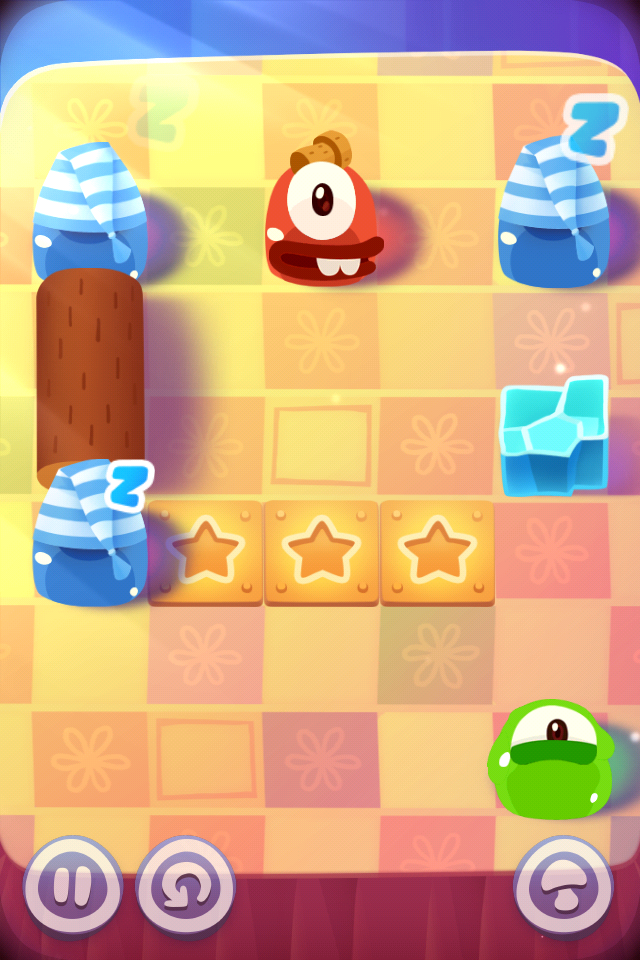
Review: Pudding Monsters for iPhone and iPad
You probably don't need to learn from me about Pudding Monsters, a top quality game from Zeptolab, the makers of the classic Cut the Rope.
The basic idea at the core of this puzzle game has been used before. You make the pudding monsters slide on the floor; once they start moving, they won't stop until they hit something. If they don't hit anything and leave the screen, you lose and have to start again.
Even if the basic idea isn't new, I don't recall it having been used this way. When two monsters touch, they join to form a larger monster. The level is solved when all monsters are merged.
There is a lot of variety in the puzzles, because all kinds of different elements are introduced throughout the game: monsters that leave a sticky trail, sleeping monsters that cannot move until another monster joins with them, ice blocks that break after being hit, cloning machines, arrows, and so on.
Additionally, there's the customary three star rating system; stars are earned by finishing the level with monsters sitting on top of the stars.
The levels don't have a single solution, and after solving all levels for the first time, the game encourages you to play them again and earn 0, 1, 2 and 3 stars; when you do that, you earn a crown.
There are also funny Game Center achievements like "form a monster shaped like a hot dog".
Curiously, I've seen this game criticised both because it's "only" a logic game (by people that expected another action game like Cut the Rope) and because it is too easy as a logic game (by people that expected some hard core logic puzzle).
I don't think those criticisms are fair. Clearly, the first thing that strikes while playing the game is the incredible quality of the presentation: the animations are beautiful and full of humour, and the sound is great too. However the puzzles, while not terribly hard, can be challenging, especially if you want to earn all crowns. I've had many a-ha! moments when an elusive alternative solution finally clicked. Frankly, I don't think we could expect anything more than this from a game that is designed to sell millions of copies.
Every time I play, I'm amazed by the beauty of the level select screen. As you flick through the pages, the image in the background zooms out, sort of like in Powers of Ten™, starting from a cup of tea, through the roof of the house, to show the whole neighborhood (for now; it's easy to guess that we'll keep zooming out with future updates).
An update was released just today, adding 25 more levels, bringing the total to precisely 100. Even that way, and even playing each level multiple times to get the crown, it still feels a bit short, and you're left begging for more. But I think the main reason for this is that the game is so utterly enjoyable that you'd want to keep playing. Hopefully Zeptolab will continue to release updates in the future, like they did with Cut the Rope.
What do you think, is this game worthy of being labelled nontrivial?
©2013 Nicola Salmoria. Unauthorized use and/or duplication without express and written permission is strictly prohibited. Excerpts and links may be used, provided that full and clear credit is given to Nicola Salmoria and nontrivialgames.blogspot.com with appropriate and specific direction to the original content.
The basic idea at the core of this puzzle game has been used before. You make the pudding monsters slide on the floor; once they start moving, they won't stop until they hit something. If they don't hit anything and leave the screen, you lose and have to start again.
Even if the basic idea isn't new, I don't recall it having been used this way. When two monsters touch, they join to form a larger monster. The level is solved when all monsters are merged.
There is a lot of variety in the puzzles, because all kinds of different elements are introduced throughout the game: monsters that leave a sticky trail, sleeping monsters that cannot move until another monster joins with them, ice blocks that break after being hit, cloning machines, arrows, and so on.
Additionally, there's the customary three star rating system; stars are earned by finishing the level with monsters sitting on top of the stars.
The levels don't have a single solution, and after solving all levels for the first time, the game encourages you to play them again and earn 0, 1, 2 and 3 stars; when you do that, you earn a crown.
There are also funny Game Center achievements like "form a monster shaped like a hot dog".
Curiously, I've seen this game criticised both because it's "only" a logic game (by people that expected another action game like Cut the Rope) and because it is too easy as a logic game (by people that expected some hard core logic puzzle).
I don't think those criticisms are fair. Clearly, the first thing that strikes while playing the game is the incredible quality of the presentation: the animations are beautiful and full of humour, and the sound is great too. However the puzzles, while not terribly hard, can be challenging, especially if you want to earn all crowns. I've had many a-ha! moments when an elusive alternative solution finally clicked. Frankly, I don't think we could expect anything more than this from a game that is designed to sell millions of copies.
Every time I play, I'm amazed by the beauty of the level select screen. As you flick through the pages, the image in the background zooms out, sort of like in Powers of Ten™, starting from a cup of tea, through the roof of the house, to show the whole neighborhood (for now; it's easy to guess that we'll keep zooming out with future updates).
An update was released just today, adding 25 more levels, bringing the total to precisely 100. Even that way, and even playing each level multiple times to get the crown, it still feels a bit short, and you're left begging for more. But I think the main reason for this is that the game is so utterly enjoyable that you'd want to keep playing. Hopefully Zeptolab will continue to release updates in the future, like they did with Cut the Rope.
What do you think, is this game worthy of being labelled nontrivial?
Summary
| Nontrivialness | ★★★★☆ |
| Logical Reasoning | ★★★★☆ |
| User Interface | ★★★★★ |
| Presentation | ★★★★★ |
| Loading Time | ★★★☆☆ |
| Saves Partial Progress | ✘ |
| Status Bar | ✘ |
©2013 Nicola Salmoria. Unauthorized use and/or duplication without express and written permission is strictly prohibited. Excerpts and links may be used, provided that full and clear credit is given to Nicola Salmoria and nontrivialgames.blogspot.com with appropriate and specific direction to the original content.
Subscribe to:
Posts (Atom)