 |
| Threes!, released February 6th |

The best iPhone and iPad games for logic puzzles enthusiasts
Showing posts with label numbers. Show all posts
Showing posts with label numbers. Show all posts
Wednesday, April 9, 2014
A Visual Catalog of Threes! Clones
If you follow gaming news, you have probably read about the big drama spurred by the developers of Threes!, who posted a detailed history of the development of their game, to show how long it took them to create it, compared to how quickly it was copied. It's a very interesting read, especially if you are a game designer, so I'd encourage everyone to take a look at it. Threes might look simple, but the process that bought to its final state was far from simple.
The one thing I don't like about this story is how all the attention has been put on 2048, calling it a rip-off of Threes. This post was initially going to be about how I don't agree with that, but attempting to prove my point I turned it into a collection of real clones of Threes, so I'll focus on those for now and talk about 2048 another time.

Tuesday, February 18, 2014
Review: Clock Day for iPhone and iPad
Clock Day by Morningtea Studios is an interesting and fun way to present something that math students might otherwise find repetitive and boring.
 It doesn't look like a math puzzle from the title screen, does it? Indeed it seems colorful and inoffensive. But what's behind the facade can get quite tricky.
Sunday, February 9, 2014
Review: Threes! for iPhone and iPad
People who follow me on Twitter had already seen the heads-up about Threes!, the latest puzzle game by Sirvo LLC.
 I wasn't the only one to notice this game, since it quickly climbed to #1 in the App Store charts, proving to be a perfect casual game. But is it also a good game for readers of this blog?
Thursday, December 26, 2013
Review: Sifar for iPhone and iPad
Sifar by Takahiro Sakuda is a game in the tradition of Japanese logic puzzles.
 Interestingly, it would have worked as a
pen and paper puzzle, and the rules are simple enough that I wondered if it had been published before,
but couldn't find any prior art.
Interestingly, it would have worked as a
pen and paper puzzle, and the rules are simple enough that I wondered if it had been published before,
but couldn't find any prior art.

Monday, December 9, 2013
Review: Atoms Puzzle for iPhone and iPad
It took me a while to fully grasp the rules of Atoms Puzzle by Wharf Games.
 It's not that they are difficult, but to play knowledgeably it's essential to have an exact understanding of the value of each piece on the board. The game however avoids showing clear numbers, relying only on the size of the pieces.

Saturday, December 7, 2013
Review: Tricky Circles for iPhone and iPad
In a normal day, there can easily be a hundred new apps released in the Puzzles category. It's impossible to even check the description of them all, but I try to be as thorough as possible because often the best games come out of nowhere.
Tricky Circles by Dmitry Chalovskiy is one of such games.
 After seeing the icon, I feared that it was just another clone of the boring Dots, but thankfully it's something completely different.
Tricky Circles by Dmitry Chalovskiy is one of such games.

Tuesday, March 26, 2013
Review: Subaku for iPhone and iPad
I'm usually suspicious of puzzle games that have "easy to learn and difficult to master" in their description, but Subaku by Eric Koziol is good despite that.
I'm also totally bored by sudoku, but thankfully, despite the misleading icon and the suspiciously similar name, this is a completely different puzzle.
If you are suspicious too, there's also a free version called subaku mini, which contains just the first 10 puzzles.
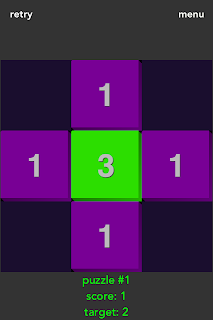
 The game is played on a 3x3 grid, containing some numbered tiles.
 when you tap a tile, its value is decreased by one, and its orthogonal neighbors are increased by one. So tapping the 4 above gives this:
 when a row, column, or diagonal contains three identical numbers, they are all removed. The goal is to clear the board.
So tapping the 3 above would give this, and solve the puzzle:
 There are 100 puzzles included; the list is well presented with colorful thumbnails, and a target number of moves needed to solve the puzzle.
Note that the target isn't always the optimal number. I'm used to being shown what the optimal number of moves is, but I'm beginning to like the idea.
 Interestingly, the 100 puzzles are not sorted only by the target number of moves. First they are sorted by the number of initial tiles, then each group is sorted by number of moves.
One of the hardest puzzles should be this one.
 There are many options, some of them quite unusual like using kanji numbers, or removing numbers altogether (and using only colors instead). There are many inventive Game Center achievements too.
Additionally to the puzzle mode, there's an endless mode where the goal is to play as long as possible without clearing the board. To make it interesting, random events happen every 5 moves. This game mode is good for casual playing.
One criticism I have is that if you tap the menu button, you are brought to a crowded screen with several unrelated options: return to game / retry / return to menu / previous / next. I think this is a confusing choice and the user interface could be simplified.
But that's a nitpick; the game has original mechanics and is fun to play, so it's easily recommended.
©2013 Nicola Salmoria. Unauthorized use and/or duplication without express and written permission is strictly prohibited. Excerpts and links may be used, provided that full and clear credit is given to Nicola Salmoria and nontrivialgames.blogspot.com with appropriate and specific direction to the original content.
I'm also totally bored by sudoku, but thankfully, despite the misleading icon and the suspiciously similar name, this is a completely different puzzle.
If you are suspicious too, there's also a free version called subaku mini, which contains just the first 10 puzzles.


So tapping the 3 above would give this, and solve the puzzle:

Note that the target isn't always the optimal number. I'm used to being shown what the optimal number of moves is, but I'm beginning to like the idea.

One of the hardest puzzles should be this one.

Additionally to the puzzle mode, there's an endless mode where the goal is to play as long as possible without clearing the board. To make it interesting, random events happen every 5 moves. This game mode is good for casual playing.
One criticism I have is that if you tap the menu button, you are brought to a crowded screen with several unrelated options: return to game / retry / return to menu / previous / next. I think this is a confusing choice and the user interface could be simplified.
But that's a nitpick; the game has original mechanics and is fun to play, so it's easily recommended.
Summary
| Nontrivialness | ★★★★☆ |
| Logical Reasoning | ★★★☆☆ |
| User Interface | ★★★☆☆ |
| Presentation | ★★★★☆ |
| Loading Time | ★★★★★ |
| Saves Partial Progress | ✘ |
| Status Bar | ✘ |
©2013 Nicola Salmoria. Unauthorized use and/or duplication without express and written permission is strictly prohibited. Excerpts and links may be used, provided that full and clear credit is given to Nicola Salmoria and nontrivialgames.blogspot.com with appropriate and specific direction to the original content.
Sunday, March 17, 2013
Review: Exponential Invasion for iPhone and iPad
I'd been keeping an eye on Exponential Invasion, a mathematical puzzle game for iPhone and iPad by Danny Perski, since it was released last year.
The premises looked interesting, but as far as puzzle games on the App Store go, I think the price of $2.99 is too high. The other day it was briefly dropped to $1.99, which I still think is too high, but in the interest of science, I bought it.
 The game has a minimalistic, polished interface, which I liked a lot.
Unfortunately, the gameplay isn't equally interesting.
First of all, the Exponential in the name is a lie—there's only addition in this game.
You play on a 5x5 grid, and you control the white numbers. You can move them one step at a time, and when you move a number over another number, they are added together.
When you have a number large enough, you can move over a blue number to "conquer" it. When you do that, both numbers disappear. When you've erased all numbers from the grid, you have won.
 Somewhat arbitrarily, you can only move a larger number over a smaller number. The only significant effect that this has, is that you cannot combine two identical numbers. This is rarely an issue.
Some cells are grey, and you can't move over them. So most of the puzzles involve finding the way to move your numbers around the board so that you can merge the right ones.
 The white numbers are only barely enough to conquer the blue numbers. E.g. in the puzzle above, the sum of the blue numbers is 22, while the sum of the white numbers is just 24. So you need to be careful about which numbers you merge: if you overshoot, you have to start again.
The later levels have blue numbers in the middle of the grid, separating the white numbers. You need to find out which blue number you can initially conquer, using only white numbers from a single group, so that you can remove it from the board and open up more merging possibilities.
 The fundamental issue with these puzzles is that they are just trivial. If you can sum numbers in your head, that's pretty much all you need to solve every one of the levels provided. In a few cases it may take a little longer to find the right combination, but it merely requires enumerating possibilities. It's not challenging, nor much fun.
There is the additional goal of solving each level in the optimal number of moves, but unlike other games I've reviewed in the past, it isn't really rewarding, and doesn't add much to the game.
I think the initial idea is a valid one, and a different set of rules might generate intersting and varied puzzles, but as things stand, I cannot recommend this game.
©2013 Nicola Salmoria. Unauthorized use and/or duplication without express and written permission is strictly prohibited. Excerpts and links may be used, provided that full and clear credit is given to Nicola Salmoria and nontrivialgames.blogspot.com with appropriate and specific direction to the original content.
The premises looked interesting, but as far as puzzle games on the App Store go, I think the price of $2.99 is too high. The other day it was briefly dropped to $1.99, which I still think is too high, but in the interest of science, I bought it.

Unfortunately, the gameplay isn't equally interesting.
First of all, the Exponential in the name is a lie—there's only addition in this game.
You play on a 5x5 grid, and you control the white numbers. You can move them one step at a time, and when you move a number over another number, they are added together.
When you have a number large enough, you can move over a blue number to "conquer" it. When you do that, both numbers disappear. When you've erased all numbers from the grid, you have won.

Some cells are grey, and you can't move over them. So most of the puzzles involve finding the way to move your numbers around the board so that you can merge the right ones.

The later levels have blue numbers in the middle of the grid, separating the white numbers. You need to find out which blue number you can initially conquer, using only white numbers from a single group, so that you can remove it from the board and open up more merging possibilities.

There is the additional goal of solving each level in the optimal number of moves, but unlike other games I've reviewed in the past, it isn't really rewarding, and doesn't add much to the game.
I think the initial idea is a valid one, and a different set of rules might generate intersting and varied puzzles, but as things stand, I cannot recommend this game.
Summary
| Nontrivialness | ★☆☆☆☆ |
| Logical Reasoning | ★☆☆☆☆ |
| User Interface | ★★★☆☆ |
| Presentation | ★★★★☆ |
| Loading Time | ★★★★★ |
| Saves Partial Progress | ✘ |
| Status Bar | ✘ |
©2013 Nicola Salmoria. Unauthorized use and/or duplication without express and written permission is strictly prohibited. Excerpts and links may be used, provided that full and clear credit is given to Nicola Salmoria and nontrivialgames.blogspot.com with appropriate and specific direction to the original content.
Subscribe to:
Posts (Atom)